You have been coding your whole life or at least most of your professional life. Recently, you have been promoted/designated or as a Lead Engineer or a Tech Lead. Does anything change for you?
Should you stop coding?
People generally say, hell no!
Hell No!
And why should you now?
You like it;
You enjoy it and probably
really good at it too.
But then you start leading a team, which means that everything should change or at the minimum, something should change Or shouldn’t?
It’s an eternal question for every engineering manager. I have tried to answer it all along my career and
The hardest thing is to understand that you are not “just a” developer anymore.
I know, the above statement is controversial with multiple of my readers.
Most of you are now in a role with,
different responsibilities,
different daily schedules, and
tasks that involve different mental processes.
And you are most likely trying to combine two things at this time.
You’re trying to be a good developer (that you used to be).
You’re also trying to act as a “Coordinator” “Communicator” and also “Manage” things
I know, your designation/title says Tech “Lead” or “Lead” Engineer and not Engineering Manager. But, in most organisations, a TL is looked upon as an EM in waiting (For more insight on career tracks for a TL – Check out my previous article on Engineering Leadership on Startups )
And working two jobs may often lead to early burning out and, frankly, not being any good in either of them.
I will take two very probable examples here.
Case 1: You are a Lead and you want to own a particular piece of code rewrite, which is giving a lot of concurrency nightmares to both the product support and your on-call teams. Most design/debug and development tasks require high concentration and focus, which contradicts the very nature of the team leader’s work. Multiple planned meetings, calls, messages — a lead needs to be on alert. It’s tough to consider all the edge cases when your slack/hangout/teams is buzzing all the time.
Another essential element is most of these buzzing & pinging can be controlled if your team is good at Asynchronous Communication. (I will write more about it in a future article)
Case 2: You are a Lead, driving a new subscription module for your latest product. There are simply so many stakeholders, your PM, Payments team, external partner/vendor, Infra team etc. It will be hard to be prepared to answer your teammates’ or vendors or customers’ questions if all you can think about is the efficiency of that function you just wrote.
Time Share:
Another thing is that spending a lot of time on development gives you little time to do your actual job as a lead/manager. And your job is managing other people. Though you will probably make time for your primary duties — assigning tasks, making estimations, validating designs, communicating with the stakeholder — you will miss out on all the other “noncrucial” parts of your job.
You can get so invested in a feature that you will miss some critical signs of your employees becoming demotivated to do their work, tired, or less happy. And, as you are busy, you become less innovative. Who will come up with a new architecture for the 3-year-old service? Most certainly not you, since you are too deep in the code.
Anti-Growth
Minefields you’d inadvertently trigger are either the Martyr Effect or the Hero Syndrome (Think Bruce Wayne or Tony Stark). On the first & second one, You’d always take the toughest part of the code or the most interesting part of the code, respectively. Either way, you’d be creating a team who’d be ill-prepared to take up challenges on their own or ill-equipped.
But what if I do not want to give up coding?
It may so happen that plain management isn’t your path. So, from here on, you may not enjoy what the role has to offer. Being a Team Lead/EM is all about people; being a Principal Engineer (or staff engineer or architect) is about code. If programming is critical for you and brings you more joy, you may be more suited for a Technical Leader role. So choose wisely.
But as a Team Lead, you are still most welcome to join code reviews and help your teammates with challenging coding problems if you want to.
Consult. Guide. Assist. Communicate
This is going to be your Motto.
And of course, You should definitely continue to code in other “Non-paying” parts of your job. Start automating your units, create boiler plates, write smaller, niche, critical elements of your system.
How to select SSO Standard for your SaaS Application.
For anyone developing any application on the cloud, the major concern is always how is security implemented. Typically, you start with an authentication system viz. Usernames & Passwords. As your application grows in size of use cases and adoption, you’ll soon find a necessity to improve your security posture, these could range from MFA, Federated Identity management and finally authorisation. You now have customers who ask if you can support their AD authorisation or OneLogin or Okta etc.
This is when you’ll think about implementing a Single-Sign-On. But, the choice of how to keep data and identities secure begins much earlier for software architects and developers: selecting the standard that should be used to keep federated identities safe. This will involve two things, architecting an authorisation system – could be a separate service or bound with your application – this choice is critical to how you can grow as an organisation.
Architecture Choice:
If you choose to integrate it with your main product and 2 months later your board directs you to develop a new offering, you’ll end up doing it all over again. On the contrary, if you’re not going to pivot to any new business line, the additional time you will incur in building an external “Accounts service” will be a tax on the GTM.
Standards Choice:
IT Administrators and Security Architects must first choose the protocol or framework to use to maintain federated identity, or the mechanism of connecting a person’s electronic identity and attributes, safe while designing a plan to keep data and identities secure.
A Single Sign-On (SSO) account has the advantage of allowing employees to log in once to an application or network and not have to log in to several apps or networks during the workday. While this is beneficial to employees in terms of increasing productivity by eliminating the need to remember several passwords, it is also beneficial to IT and Security functions. The Identity and Access Management (IAM) platform responsible for maintaining employees’ credentials can assist make it more manageable by registering fewer passwords in the system.
It is, however, not an easy choice. Security Assertion Markup Language (SAML), OpenID, and open authorization are the leading candidates in the federation process (OAuth). Let’s take a closer look at these technologies and determine when SAML, OAuth, and OpenID should be used.
What is Single Sign-On (SSO)?
SSO (Single Sign-On) is an authentication method that allows apps to validate users by using other trustworthy apps. Single sign-on allows a user to use a single ID and password to log into several applications.
SSO is an important part of an Identity and Access Management (IAM) platform for managing access. User identity verification is crucial for establishing what permissions a user will have.
SSO Standards
SAML
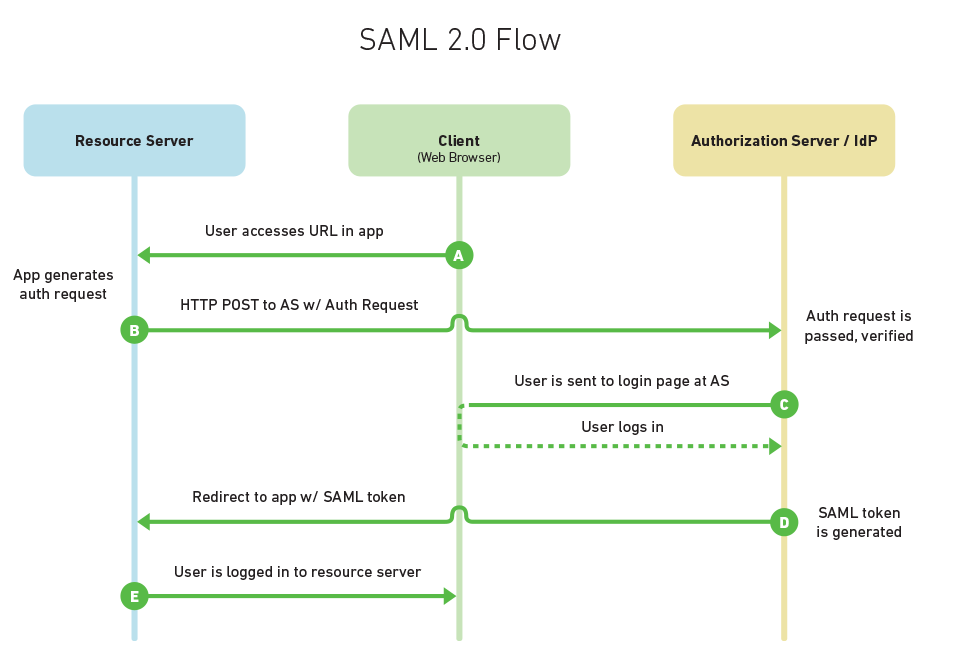
SAML is a protocol that allows an Identity Provider (IdP) to send a user’s credentials to a service provider for authentication and authorization. SAML allows for Single Sign-On (SSO) and streamlines password management. It is beneficial to businesses because employees are using an increasing number of applications to complete their tasks.
Keeping track of passwords for hundreds of programs used by hundreds, if not thousands, of employees can be difficult. SAML comes to the rescue by providing a single sign-on standard for businesses.
OAuth
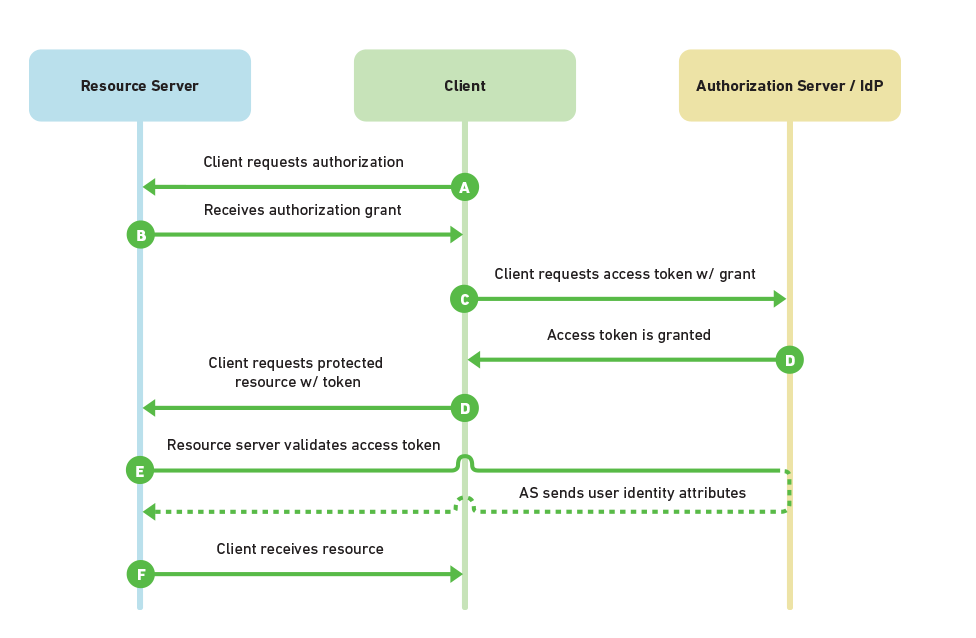
OAuth 2.0 is a secure authorization standard. It allows secure delegated access by providing third-party services with access tokens rather than exposing user credentials. It does not, however, authenticate; it just authorizes.
You’ve probably used OAuth 2.0 if you’ve ever signed up for a new app and consented to allow it automatically source fresh contacts from Facebook or your phone contacts. This standard ensures that delegated access is secure. This means that a program can operate on behalf of a user and access resources from a server without the user needing to provide their credentials. This is accomplished by allowing the Identity Provider (IdP) to issue tokens to third-party apps with the user’s permission.
OpenID
The OpenID Connect (OIDC) standard is used for authentication. OIDC is used by identity providers (those who generate and administer identities) so that users can log in with their IdP first and then access applications without having to re-enter their credentials.
This authentication option is recognizable if you’ve used your Google account to sign in to apps like YouTube or Facebook to log into an online shopping cart. Organizations use OpenID Connect to authenticate users, and it is an open standard. This is used by IdPs so that users can sign in to the IdP and then use their sign-in information to access other websites and apps without having to log in or disclose their sign-in information.
SAML VS OAuth VS OpenID
OAuth 2.0 is a framework for regulating authorization to a protected resource, such as a program or a set of files, whereas OpenID Connect and SAML are both federated authentication industry standards. As a result, OAuth 2.0 is used in quite different situations than the other two protocols, and it can be used in conjunction with either OpenID Connect or SAML.
OpenID Connect is based on the OAuth 2.0 protocol and uses an ID token, which is a JSON Web Token (JWT) that standardizes areas where OAuth 2.0 provides for flexibility, such as scopes and endpoint discovery. It depends on user authentication and is often used to make user logins easier on consumer websites and mobile apps.
Unlike JWT, SAML does not rely on OAuth and instead relies on a message exchange to authenticate in the XML SAML format. It’s more commonly used in enterprise settings to allow users to log in to several applications with a single password.
Final Thoughts
As technology advances and systems become more interconnected, federated identification becomes increasingly useful since it is more convenient for users. It saves them time by reducing the number of accounts and passwords they have to remember, but it raises some security concerns.
SAML has one feature that OAuth2 lacks: the SAML token contains the user identity information (because of signing). With OAuth2, you don’t get that out of the box, and instead, the Resource Server needs to make an additional round trip to validate the token with the Authorization Server.
On the other hand, with OAuth2 you can invalidate an access token on the Authorization Server, and disable it from further access to the Resource Server.
SAML provides a simpler and more standardized solution which covers all of our current and projected needs at ITILITE and avoids the use of workarounds for interoperability with native applications.
Business Value Delivery by Engineering Teams in StartUps – Part 2
In this multi-part post, I will try to articulate my view on the importance of business value and its delivery by engineering teams. This is the second part, where I will share my perspective on the “How of it”.
Part 2: The How of it – Define, Visualise, Prioritise, Develop, Deliver & Measure.
The first thing a “Tech” Founder need to do is define the Systems Development Strategy. At a very high level, the systems development strategy should detail the state of the current/planned systems, the high-level business strategy for the next 2-5 years and maps out a plan to get there. An engineering leader will drive the creation and implementation of the development strategy to ensure the business can meet their current and future needs. Working closely with architects and technical leads, the engineering leader can formulate a solid development strategy.
The development strategy should detail the core architecture direction and technologies for the systems, including high-level plans for delivery. The development strategy is the crux of all efforts to deliver business value. Without a firm foundation of proper system architecture and technology, the business will have a difficult time delivering the value they need to survive.
If you’re an Engineering Leader who joined the startup after the MVP is created, it is your responsibility to understand the business strategy and formulate the Development Strategy as early as possible.
If your startup doesn’t have a solid development strategy or similar document, the following is a great place to start:
Gather business needs: Gather high-level business needs/strategy to cater for the now and future (2-5 years) horizon. Not a deep dive, but deep enough to judge existing systems and measure other options. (Question like How many new new users will be added month-on-month, what is the order of magnitude of transactions we plan to rake, is it thousands or millions or tens of millions – Each will point you in a different direction on the system design)
Review of existing systems: Analysis of current systems around fit for purpose and whether it can be maintained and extended to meet the future needs uncovered in the above. (The MVP may seem to work fine and it will be tempting to build “On-Top” of it with a plethora of “Features”, resist the urge and pressure, if applicable)
Technologies / Architecture: Based on the review of the first two bullet points, you may recommend a strategic direction. The decision here could range from rebuilding the entire system with a new solution, to replacing components of the system with off the shelf/Open-source components. Alternatively, you may find the existing system is a strong foundation which needs modernising or scaling. In which case, the development strategy document would detail a range of architectural and technologies for future development.
The above is a good starting point and will allow the business to get started on implementing the development strategy. You may do it even before starting with the Startup and make it a Pre-Joining exercise with the Founders and Senior folks. At the end of this exercise, you will have performed an extensive analysis of the current systems and have a strategic direction for the systems.
2). Help the Business Define Requirements
It is essential to understand what needs to be delivered before you can go ahead and deliver the next Amazon or Airbnb. It has been my experience that on occasion, the business will need some “External Inputs” to finalise what is required.
When the business has a lot of ideas for improvements, they can sometimes get muddled together and lost. To counter this, we at ITILITE do a “Quarter Theme“. Before ITILITE I worked with Zarget, where we had a similar “Themed Quarterly Roadmaps” as well. This “Theming” helps in prioritising the focus areas. More on that in the next section
After which, we can visualise the entire scope of these ideas using User Story Maps. User story maps are visual representations of functionality requirements where all the requirements documented using a system of cards. It becomes a more straightforward (not easy) task to slice and dice these requirements using a story map to cull anything that is not critical to the business.
For the remaining requirements, we need to gather a little more information to progress to the next step, for each requirement we need to capture:
Description: High-level description of the change. Not a HLD/LLD but enough to provide a high-level order of magnitude estimate.
Business benefits: Here we are looking to understand what benefits we can expect from the business change.
High-Level estimate: Order of magnitude level estimate, lots of refinement to still take place, however, gives us a good idea around sizing.
Business SME and Sponsor: Details of people we can go to get more information.
The detail we capture for each of these changes is small, the reason being these items are a wish list only and not confirmed, so we do not want to waste more time on these then we need (lean thinking). While it is the domain of product managers and business analysts to flesh out business requirements and benefit statements, the engineering leader also plays an essential part in this process. Engineering leaders can use their experience to provide the high-level estimates for development, or indeed recommend ways to implement the requirement without the need to write additional code.
Another area where engineering leaders should influence is ensuring and non-functional (technical strategy items or technical debt) is included for development prioritisation. These technical plumbing is not attractive to the business but could be critical for the business to achieve their long term goals. Engineering leaders are the people that need to fight to ensure they are on the table.
Also, while you analyse requirements, where possible, try to group requirements where they affect the same code or system module. Grouping requirements will assist us in prioritisation, sequencing and hence the Go-To-Market, which is a key parameter for the business. The last thing we need to do is storing these requirements in our product backlog, to be reviewed and prioritised by the business in our next step.
3) Visualise the work and prioritise
In our third step, we are getting closer to the business deciding on their valuable items. Taking our list of requirements from our product backlog, we now present these to the business to discuss and rank in order of importance.
As discussed above, there will always be x+n “Projects” in the asks. Where “x” is the number of features you can effectively deliver in the timeline. And all “Projects” will look like they are P0 to solve.
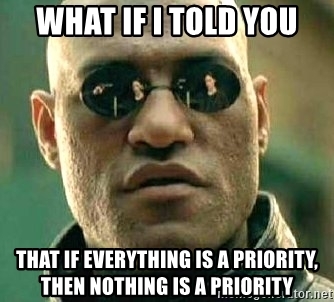
If Everything Is a Priority, Then Nothing Is!
Well, the quote wasn’t from Morpheus, I just liked that Meme (it is debated to be in between Yuri Van Der Sluis and Garr Reynolds)
Having an extensive list of items to visualise enables the business to understand that we cannot have everything, and need to select the items that will make the most significant difference to their business (i.e., highest business value).
This is again, not because of intent, but because of trying to do “Too-Many” things and “Too-Soon”. Independently, all of the asks may sound truly important. Every Leader/Function within your Start-Up will come with several competing “Projects”. The Finance Team may want that flashy invoicing module or an ERP integration with your suppliers/customers, the Customer Success would want that Advanced Analytics platform integrated, The Support Teams may want that long-standing “Quirks” on the product ironed out. Left to Engineering, this is a sure recipe for disaster. This is where a Strong Product Leadership helps!
A business analyst or product manager typically runs these planning and prioritisation meetings. However, the engineering leader also has a place at the table to provide insight and assistance to the businesses decision-making process. Who from the business should attend these meetings? It is essential to gather a broad cross-section of business stakeholders for every Department or Function that uses the Product in question. We don’t want one department having too much influence that may not be of benefit to the business.
The meeting could have the following Agenda:
Review items: The group will discuss each item in the (curated) product backlog in an open and honest discussion.
Accept or reject: The item will be approved for development or rejected. Rejected items will have their requestor notified, to ensure they are in the loop.
Ranking: Approved items get added to the backlog in priority order.
At ITILITE, We have the backlog/Thematic items in a Google Sheet, which is distributed at least a week before the meeting to ensure the Leaders have enough time to review, ask any questions before the meeting to ensure a smooth meeting. During the meeting, we view the sheet, top to bottom taking notes where required.
At the end of this meeting, we have something special. We have a prioritised list of business value and Key Outcomes.
The prioritisation meeting can be held quarterly or monthly, depending on the speed of change in your Start Up. We do it on a quarterly cycle to meet with the Leadership, so as not to overload these folks from actually getting their work done.
If the business has urgent changes which require attention, an emergency prioritisation session can be called-in where a meeting can occur to review and approve changes to the delivery schedule. Alignment should happen outside on one-on-ones and this meeting is a platform for other leaders to either ascent or dissent on the re-prioritisation.
4) Schedule and communicate delivery
In the fourth step, we now have a list that ranks all the business requirements in priority order. We now have confidence that the business indeed wants these work items completed and the order they prefer. The engineering team can now spend time working out how to deliver these items. Remembering from step two, we gathered very high-level requirements, (so not to waste time before they were endorsed), we now need to finish fleshing these items out enough to commence delivery.
There are a few mechanisms we can use to gather the information we need to get going, and the main one I like is the feature or project kickoff & inceptions. The kickoff is a process where we get the delivery team together to discuss the work that needs to be delivered. Inceptions can run anywhere up to a few weeks for big projects; it depends on how much time you allow here. During our inception, the delivery team all get on the same page with the requirements in question and can ask questions of each other or the sponsor to get all the information they need.
Technical delivery decisions can also be made, including creating simple prototypes to test out delivery options. Once the inception is complete, the delivery team have all their information, more confident delivery estimates are possible, sprint planning can take place, and the overall delivery schedule is known.
From here, the final step is the communication of the delivery schedule to all relevant stakeholders. Ensuring people can ask questions or point out any problems they see with this schedule.
5) Deliver value often get feedback
The final step here is to get the job done. The best way to deliver software is in small chunks completed during our sprints (typically two-week blocks). Sprints are the quickest way to deliver business value, allowing the business to gradually use this value much quicker than waiting for a monolithic release to occur.
At the end of each sprint, the team should be running product demo events. A product showcase allows the product and engineering teams to show off their excellent work to the business, who have an opportunity to provide their feedback on the product. This can start even before the first “releasable” product is out. It can start with mockups, design and prototypes. Then it will progress to V0, V1 and so forth. This feedback loop is another mechanism to ensure we are hitting the mark in terms of the delivery of business value.
Conclusion
I hope i was able to do justice to the process in this article. The key to delivering business value is having close relationships with the stakeholders, ensuring that they are involved in each step of the process. The business stakeholders are the only folks that can define business value. However, it is the role of engineering leaders to ensure proper technical oversight takes place to ensure the timely delivery of business value.
Business Value delivery by Engineering Teams in StartUps – Part 1
In this multi-part post, I will try to articulate my view on the importance of business value and its delivery by engineering teams. While most of this is written from the view of a StartUp, some elements of an established organisation are also used.
Part 1: Defining Business Value & Role of Leadership in it.
Business value is a concept that can mean multiple things to multiple people and the tricky part is all of them could potentially be valid. A product manager may value a long list of features that his/her customers have demanded for months. Another Product Manager working with internal teams to improve efficiency (revenue) will value the enhancements the accounting or support team was after. While the support manager may value a more stable product to keep the customers, s/he deals with happy.
Business value & impacts are a difficult thing to define and deliver, while it is even more difficult to measure.A collaborative effort is required to define and deliver business value, with consideration needed to ensure all voices are heard.
While most of what I will be covering in this article is typically the purview of product management, I have learned that engineering leaders have a critical role to play in this space. (Will write more on that in the next part.)
Engineering leaders bring product development experience and technical expertise to the table to provide a crucial element to the delivery of business valuewhich I will try and explain in this article.
What is Business Value?
I would define “Business value” as any improvements to systems, processes or people that augment the products or the ability to deliver products or services to the customers, thereby increasing the revenue or experience or both. No two companies will have the same definition of business value. Forget two different companies, a company in its 5th year will have a very different perception of value to its first year. This is due to their products and customers being different and requiring different elements to add value. One company may find value in the ability to build out its new product offering quickly. While another may find value in responding to customer support requests in a timely manner.
Due to the rapid changes around us, the things that businesses value changes often. Companies often face new challenges that require a quick response.
“Be agile, be nimble” is the key phrase.
These challenges can come in the form of new product features released by competitors, or a specific feature requestby a key customer, or changes in the market that render the current product/feature obsolete. Business needs or desires, therefore change just as quickly as any of these external changes.
You have probably worked for a company that comes to the engineering team with new requirements, seemingly daily?
It is not because they cannot make up their mind; It is in response to the changing business needs. This changing goalpost is one of the main reasons that Agile development practices have taken precedence from more traditional waterfall methodologies for software development.
Reacting to change and delivering business value with haste is a crucial area of importance for modern businesses. All companies exist for a purpose. The majority of companies exist to return a profit for their owners (individuals or shareholders), while some companies exist to provide a social service. The critical thing to note is that they all exist to fulfil a specific purpose which guides their definition of business value.
No matter the company large or small, if they stop innovating, and their products or services stop being relevant to society at large and market in particular, that company will whiter and eventually die.
Kodak is a prime example of this occurring in recent history. In today’s world, IT, whether it be hardware or software, is the largest driver of business value. It is therefore critical that the software engineering teams keep delivering the things that the business need to fuel their innovation.
We, as engineers, are not employed to just build that shiney app in the latest technologies, but to deliver our contribution in support of the business purpose (If not drive it!)
The importance of Engineering Leadership in Delivering Business Value
An engineering leader is, of course, a People Leader, and s/he is also responsible for the Execution, both technology and delivery of the engineering team. However there is a third dimension which often goes unrecognised, is that great engineering executives must also be great Business Leaders; they help drive alignment with other leadership/executives and shape the strategy and direction of the business itself.
It is this underutilised/forgotten element which I will try to detail here.
A People Leader & an Execution Champion:
Engineering leadership is often naively thought of as being simply a great Architect or Engineer or a Manager. But most of you already know it’s more than that. Team leadership will involve some combination of team building, culture, leadership development, and performance management.
For detailed coverage on Engineering Leadership – Please checkout my Previous Post
Most of this responsibilities will be bang in the middle of the comfort-zone of a rising Engineering Leader. But one of the hardest things for most engineering leaders as we scale is, to continue having an accurate forecast of when products and features will be delivered – what the business always asks for.
That is partially because this bleeds into the third, and the least recognised dimension of engineering leadership.
The Missing Sauce: A Business Strategist
Engineering leadership isn’t just about delivering products faster, or making engineers more productive. It’s about guiding the team in the same direction as the business, about continuously improving, and it’s about being the voice of engineering as a part of the decision-making process of the executive team. Of course, these are all dependent on our ability to understand the work our engineering teams are doing and how it aligns to business goals.
The third dimension – Business Alignment – is often overlooked or made difficult by other executives, but is absolutely necessary for the management of a successful engineering org. This is the strategic practice of engineering management, and all operational decisions depend on it. Business alignment means ensuring your organization is focused on the right projects that align with the business’s goals.
The Product org can detail/design and Engineering org can build as many features as they can agree on, but what/how does it matter, if they do not align with the business objectives or goals? Business alignment involves the right allocation of resources that supports business objectives, and helping to drive those business decisions of which projects are strategically important. (at itilite, this is always the First Principle)
How do we deliver business value?
So how do we actually deliver business value? Business value isn’t created by a soloist delivering a virtuoso performance, but a collaboration of the business, product, engineering and customer success teams working together to realise a shared vision.
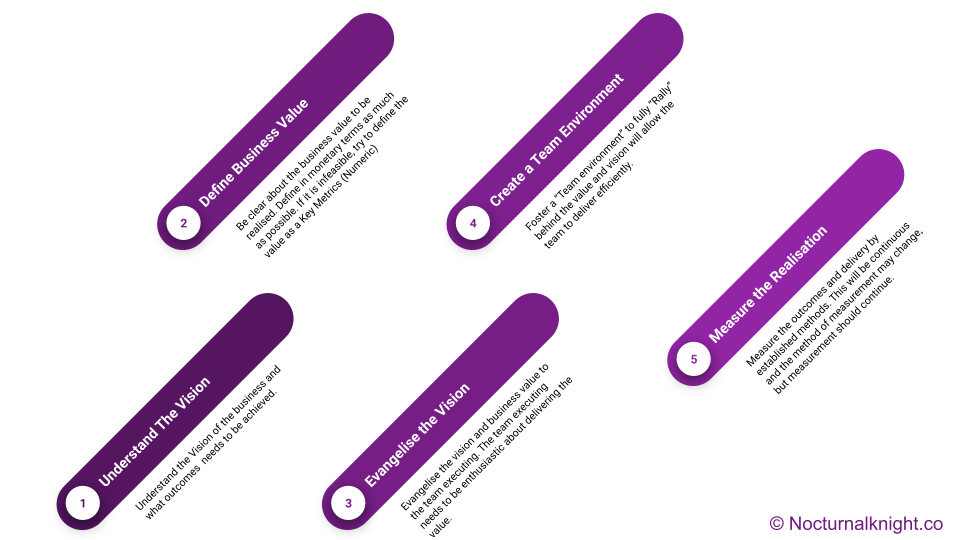
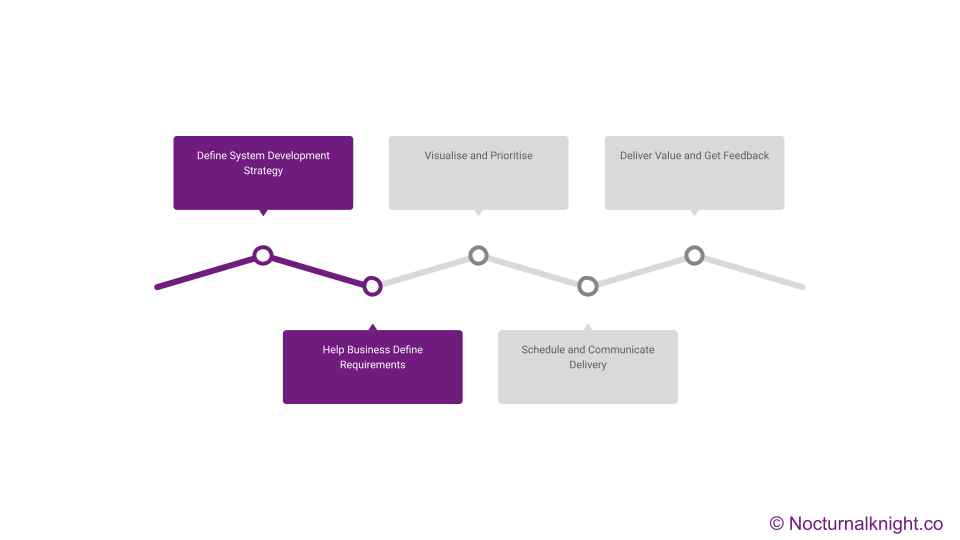
Below are the five ways this can take place; together, these provide a roadmap for delivering business value;
Define systems development strategy
Help business define requirements
Visualise the work and prioritise
Schedule and communicate delivery
Deliver value often and get feedback
I will try to articulate through each of these one at a time and dig into a little more detail in Part 2 of this article.
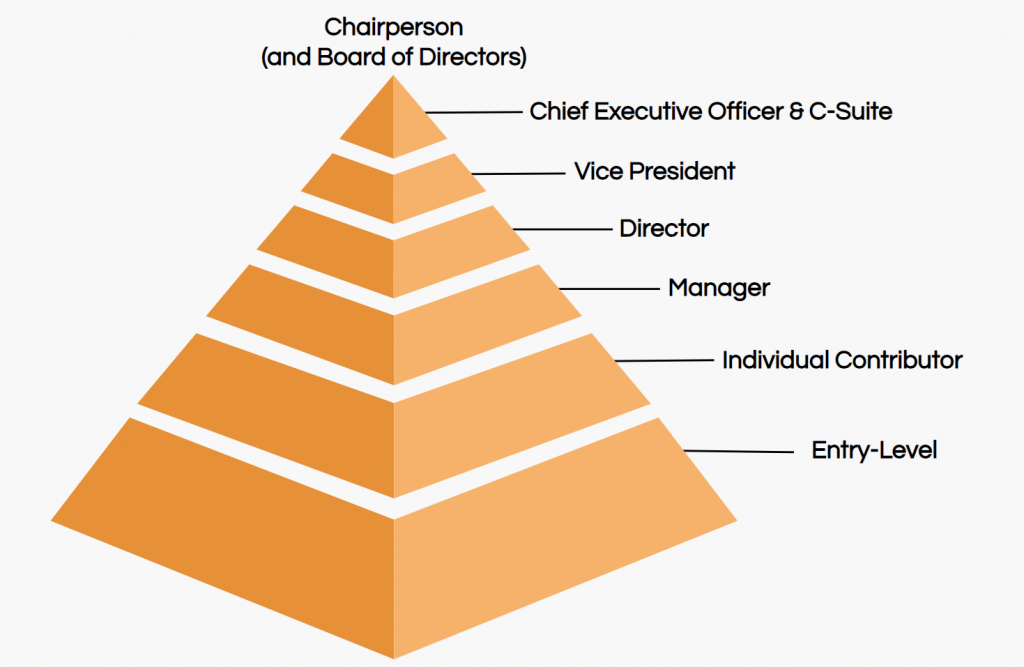
Engineering Leadership in Start-Ups: Engineering Manager, Director, VP of Engineering.
This post is partly the result of my discussions with our People practice leader and talent acquisition executive. ITILITE is at a phase of growth, where are looking for more engineering & product management bandwidth. And I had to think hard to write the various Job-Descriptions. So, I have tried to generalise it using my experiences from the last 2-3 stints. In case you’re interested to explore an Engineering Management role with ITILITE, please get in touch with me or write to careers{at}itilite.com
Engineering Leadership
As apps are becoming increasingly omnipresent and in most cases, there is a startup behind them. Engineers make up to 70% of a tech startup’s workforce, there is an increasing need for managers who look after those developers. As a result, there is a rise in the number of engineering managers in recent years. Engineering managers are responsible for delivery teams that develop these “Apps”. The following is a very generalised version of what you could do in these roles and a possible career progression.
Engineer to Tech Lead/Lead Developer
The first step in your journey from an Individual Contributor(IC) to a management role. This could be a mix of people management, delivery management, process management etc, depending on the context of your organisation. In most organisations, it is a “technical mentorship” role with some aspects of people management, quality and delivery ownership.
Most Tech Leads are natural technical leaders. They are great engineers on their own, they were well respected by the engineers around them, they worked reasonably well with the team, they understood how the product/module was designed, built and shipped, they had a decent sense for making the right kinds of product tradeoffs and they were willing to do just enough project management and people development to keep the team/project humming along.
In this role,
Most TLs would retain some independent deliverables in addition to anchoring and owning the deliveries of their team.
Most of the team still works on the same module/feature or sub-system
They do code & design reviews, suggest changes and have the final say for their modules.
Together with the Product Managers, they “own” the feature/module.
The next step in the Engineering Manager. In this role, you will be “Managing” a collection of inter-related modules/projects. In this role, the focus on timely delivery, people management and quality are higher than technical design & architecture. But, you are very much an Engineer and may be required to occasionally write quick hacks, frameworks for your developers to build atop.
The main difference is you will be responsible for the delivery of multiple projects in a related area. You will be expected to optimise the resources (Devs, Testers, etc.) available with you to maximise the outputs of your group, across multiple projects/modules
In this role, you’d be
Expected to actively engage with the Product Management teams to define what needs to be built
Defining how you will measure the outcomes of what your team is building and quantify the outcomes with metrics
Ensuring quality, getting stakeholder alignment and signoffs
Macromanage the overall deliverables of your group
The Pivot – Tech, Product, Solution Architect
The next step in your career gives you two options. One with people management, P&L accountability and other a purely technical role. If you’re planning for a pureplay technical role, some organisations have Staff Engineer, Principal Engineer etc. In essence, they are mostly a combination of Tech Lead+Architect type roles. Depending on your seniority/tenure and organisational context, you may be reporting to an Engineering/Delivery Manager, Director/VPor the CTO. In this rolw,
You will work closely with Engineering Managers, Quality Assurance leads/managers and Product Owners to design the system architecture, define the performance baselines
You will work with Tech Leads and Sr.Devs to drive the performance, redundancy, scalability among other stuff.
You will be called into discussions/decide when the team can’t reach consensus on engineering choices
Engineering Manager to Director of Engineering
A Director of Engineering role is completely different. You now have multiple leads+managers, likely multiple projects within a general focus area of the organisation. This will mean there will be way more individual deliverables and project milestones than you can track in detail on a regular basis. Now you have to manage both people and projects “from the outside” rather than “from the inside”. You’ll likely start appreciating the metrics and dashboards, as they will help you in tracking those multiple projects and deadlines, schedules, overruns etc.
You have to make sure that your managers and leads are managing their resources appropriately and support them in their effort rather than managing individual contributors and projects directly.
Lots of great technical leaders have difficulty making this transition.
While being an engineering lead/manager is certainly managing, it’s type of managing from “within the project” is much easier than “managing from outside the project” and as a director, you almost always have to manage multiple people and projects “from the outside”.
Also, as a director, you will be responsible for a number of aspects of the culture, such us
What kind of people are you hiring, setting responsibilities and workload expectations,
What is the team(s) doing for fun, how do they interact with other functions
What kinds of performance is rewarded/encouraged vs punished/discouraged.
Now, moving to some serious responsibilities, you may be the first major line of responsibility for what to do when things does not work,
an employee not working out,
a project falling behind,
a project not meeting it’s objectives,
hiring not happening in time, etc…
While most of these things are the direct responsibility of the engineering manager, the engineering manager is usually not left to face these issues alone, they work on it with the director and the director is expected to guide the process to the right decision/outcome.
I’ve seen people who were great technical leaders and good engineering managers who did not enjoy being a director at all (or weren’t as good at it) because it was a whole different type of managing bordering the administration.
Director to Vice-President
The VP of Engineering is the executive responsible for all of engineering. Development, Quality, DevOps and partly to Security and Product Management as well. While both the engineering manager and director of engineering have managers who themselves have likely been engineering managers and directors before, the VP may work for the CEO (in an early stage Startup or a smaller company) who has never been a VP of Engineering before.
A large company may have multiple levels of VPs, but in most cases, you work for someone who hasn’t been a VP of Engineering or doesn’t actually know how to do your job. This means, there simply is no first-hand experience from your Manager, that you can rely on to solve your problem. The first time you step into that role and realize that, it’s a sobering thought. You’re a pretty much on your own to figure things out. Not only are you completely responsible for everything that happens in the engineering organization, but when things aren’t going right, there’s pretty much no help from anywhere else. You and your team have to figure it out by yourselves. Many successful VPs eventually come to like this autonomy, but it can be a big adjustment when moving from director to VP.
At the director level, you can always go to your VP for help and consulting on difficult issues and they can and should help you a lot. At the VP level, you may consult with the executive team or the CEO on some big decisions, but you’re more likely talking to them about larger tradeoffs that affect other parts of the company, not how you solve issues within your team.
As a VP, you are primarily responsible for setting up processes and procedures for your organization to make it productive:
Team/Project tools such as bug system, project tracking, source code management, versioning, build system, etc.
Defining/improving processes to track, monitor and report on projects.
Defining processes to deal with projects that run into trouble.
Hiring: How you hire? What kind of people do you hire? how do you maintain the quality of new hire?
Firing: When someone isn’t working out, how do you fix it: reassignment, training, performance plan, transfer, firing?
Training: How does your team get the training they might need, it could be hard-skills, soft-skills or managerial
Rewards: How do you reward your top individual contributors and for your top managers?
You may be part of the Leadership “Council” or participate regularly in business discussions that may or may not concern your department directly. In a startup, you are often “the” technical representative on exec staff. You help craft the strategy of the business. You are relied upon for technical direction of the company (sometimes with the help of a CTO).
As a VP, you are expected to understand many important aspects of other departments, what is important to other departments and how your department serves or interacts with or depends upon other departments. Two classic example might be,
Sales depending upon certain product features/capabilities being delivered in a given timeframe to be able to convert a prospect.
Customer success depending upon certain product fixes being delivered in a given timeframe.
As a VP, you will participate in the setting of these timeframes and balancing these against all the other things your department is being tasked to do.
—
As you can see, Engineering Management/Leadership is a very interesting career option. We have multiple opening across Product and Engineering functions at ITILITE. Please see if any of these roles interest you.