The Silicon Mirage: Why Generative AI Cannot Replace Security Operations

Across the software industry, major technology vendors promote a compelling vision of AI in Cybersecurity5.
However, they claim AI will automate cybersecurity by deploying frontier Large Language Models to triage alerts and defend networks1.
Direct Answer : Does AI in Cybersecurity Eliminate SOC Alert Fatigue?
No. While generative AI processes text quickly, unguided LLMs fail to evaluate global repository execution contexts. Applying standalone LLMs to source code replaces traditional static analysis false alarms with probabilistic hallucinations, generating up to 7.59 false vulnerability tags per function and requiring extensive manual human auditing.
Traditional Static Analysis Failure Modes and Alert Fatigue
The primary driver for integrating AI into cybersecurity workflows is severe alert fatigue.
Moreover, traditional analysis tools (SATs) such as CodeQL and Infer rely on rule-based pattern matching to audit source code.
Additionally, in enterprise software environments, these traditional tools routinely suffer from false-positive rates exceeding 95%.
Triaging each false alert requires human security engineers to spend 10 to 20 minutes conducting manual code reviews5. Moreover, in AI in Cybersecurity, this burden creates bottlenecks and increases the risk of unaddressed zero-days4.
AI in Cybersecurity: The Hallucinated False-Positive Cascade in LLM Code Audits
Commercial vendors positioned generative AI as a turnkey replacement for manual code auditing, arguing that contextual language understanding would resolve traditional tool limitations4. However, applying unguided LLMs to repository-scale vulnerability detection creates a secondary failure mode: the Hallucinated False-Positive Cascade1.
Additionally, standard LLMs evaluate code snippets without complete, deterministic execution context.
They over-associate local syntactic patterns with known vulnerability definitions.
Peer-reviewed evaluations reveal the specific failure metrics of unguided model deployments.
- Function-Level Tagging Overkill: Evaluating single functions with standalone LLMs produces an average of 7.59 vulnerability tags per function, generating between 6 and 9 semantic misalignments per code block6.
- Dependency Fabrication: Autoregressive prediction mechanisms introduce a 19.7% package dependency fabrication rate during automated software repair and patching tasks6.
- Review Burden Inflation: Rather than eliminating manual triaging, unguided AI forces human security teams to audit hallucinated security flaws and non-existent software dependencies1.
Analysis Paradigm Primary Failure Mechanism Operational Impact on SOC Teams Key Quantitative Benchmark Primary Source Traditional Rule-Based SATs Syntactic pattern over-matching without semantic intent Severe review backlog; critical bugs missed in alert noise >95% false-positive rate across enterprise codebases 5 Unguided Generative LLMs Autoregressive token hallucination without global context Secondary review layer; triage of fabricated packages 7.59 false tags/function; 19.7% package fabrication 1 Neuro-Symbolic Hybrid (HITL) Combined static rules, LLM contextual filtering, and sandboxing High-precision triage; automated false alarm suppression 94%–98% false alarm reduction; 97% surface reduction 4
The K9 Paradigm: Building Human-in-the-Loop (HITL) AI in Cybersecurity Systems
To leverage artificial intelligence effectively, modern defence architectures must adopt the K9 Paradigm.
Moreover, this helps avoid reasoning hallucinations.
Direct Answer Box: What is the K9 Paradigm in AI Cybersecurity?
The K9 Paradigm is a Human-in-the-Loop (HITL) operational framework that pairs high-speed AI sensory capabilities with a trained human security analyst ("handler" or "proctor"). The AI sweeps vast telemetry log volumes and isolates candidate anomalies, while the human handler provides context, conducts deterministic verification, and retains operational command.
In physical security operations, a K9 working unit pairs a specialised canine with a trained human handler, AI in Cybersecurity. The working dog possesses scent-detection capabilities far exceeding human biology, though it cannot evaluate legal intent or navigate tactical objectives. Consequently, the human handler defines search parameters, interprets signals, verifies targets, and retains command authority.
In AI in Cybersecurity terms, generative AI acts as the K9, while the security analyst is the handler.
The AI excels at processing log streams, summarising raw telemetry, and identifying potential anomaly vectors.
However, threat validation, operational context, and remediation decisions must remain anchored to a human-proctored verification pipeline.
Neuro-Symbolic Architectures and Closed-Loop Verification
Empirical research confirms that neuro-symbolic security systems combine deterministic rule checks, natural language model reasoning, and human-in-the-loop validation.
Moreover, they substantially outperform unguided AI applications.
- Entry-Point Reachability Filtering: Systems such as OpenAnt decompose enterprise software repositories into modular units reachable exclusively from external execution entry points4. This filtering process eliminates unattainable internal code paths, reducing the code volume requiring security analysis by approximately 97%4.
- Automated Exploit Sandboxing: Once candidate vulnerabilities are identified by AI context engines, the pipeline automatically generates isolated, sandboxed execution containers to test exploitability before escalating an alert to human handlers16.
- Industrial Noise Reduction: Deployments across enterprise software environments at Tencent demonstrate that integrating static analysers with custom LLM filtering suppresses 94% to 98% of false alarms, dropping manual inspection costs from 20 minutes per alert to a few seconds17.
- Meta-Prompt Workload Reduction: Implementation of structured meta-prompting frameworks (such as LARA) reduces human audit verification workloads by 40%14.
- Multi-Agent Cognitive Debate: Frameworks such as ReasonVul deploy three specialised LLM agents in structured debate loops, leveraging cognitive synergy to correct individual model hallucinations before reaching human analysts15.
Geopolitical Cyber Warfare: The Physical Limits of Application-Layer AI
While commercial software vendors focus on application-layer source code analysis, state-sponsored cyber actors operate across supply chains.
They also target hardware components, operational technology (OT), and industrial control systems (ICS)6.
Moreover, cloud-hosted generative AI models are blind to microchip manipulation and kinetic OT breaches7.
Finally, recent defence incidents involving United Kingdom military assets and energy infrastructure demonstrate these operational boundaries6.
Case Study 1: Royal Navy Kraken K3 Scout USV Hardware Supply-Chain Breach

However, in August 2026, a routine audit by the UK Ministry of Defence identified a critical supply-chain breach.
Moreover, this breach highlights AI in Cybersecurity considerations for the Royal Navy’s uncrewed surface vessel (USV) fleet.
- The Platform: The K3 Scout USV, manufactured by British defence contractor Kraken Technology Group, is a 600 kg payload autonomous vessel designed for 30-day continuous maritime operations12. The £12 million fleet, operated by 47 Commando and the Coastal Forces Squadron, was actively deployed for force protection and operational preparations in the Strait of Hormuz18.
- The Vulnerability: Despite formal supplier assurances of compliance with US National Defence Authorisation Act (NDAA) standards, the vessel’s primary camera sub-components originated from China13. Routine cybersecurity testing revealed that these cameras were secretly sending unauthorised “heartbeat communications”, connectivity signals confirming device operational status to an external IP address located in China13.
- Forensic Audit: Investigative findings indicated that the background data transmissions had persisted undetected since 2021, remaining active even when the primary vessel systems were powered down16.
- Operational Impact: Although an MoD investigation concluded that no classified military telemetry had been compromised, the Royal Navy stripped internet connectivity from the entire fleet’s camera architecture6. Kraken Technology Group admitted that component origin verification had failed, severely damaging confidence in the platform—which had recently secured a $49 million contract with US Special Operations Command (SOCOM) and participated in NATO Baltic Sea trials6.
However, no conversational AI assistant evaluating software code could have identified or prevented this compromise. The vulnerability existed entirely within physical hardware supply chains and embedded microchip firmware6.
Case Study 2: UK Power Generation Plant Cyber Offensive, July 2026
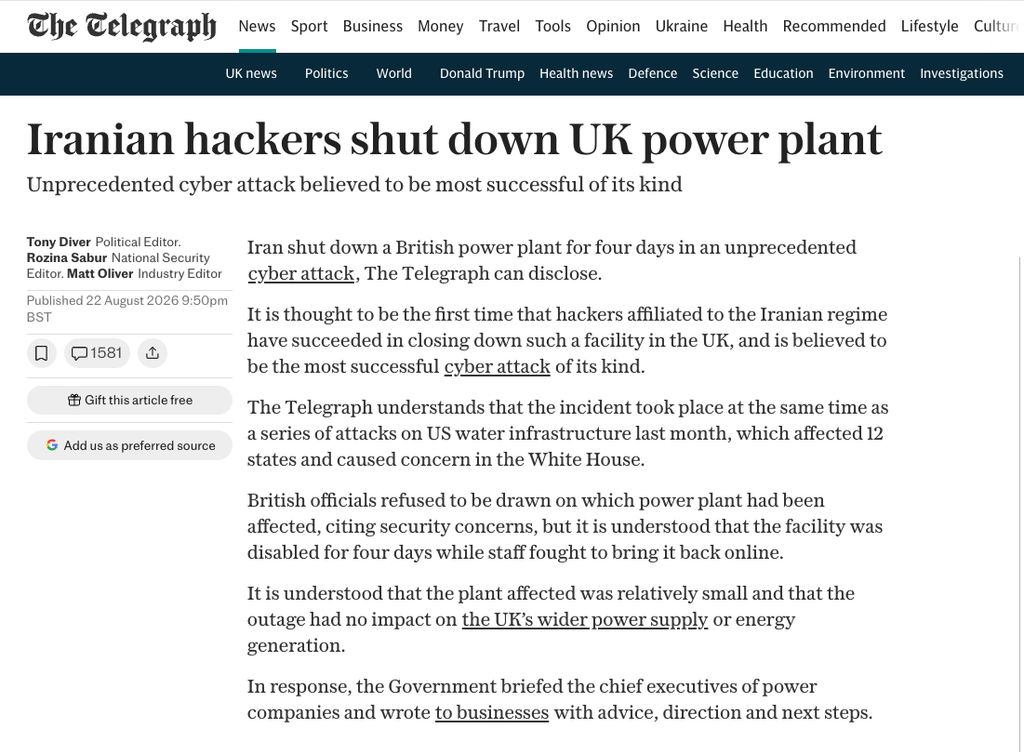
In July 2026, state-linked Iranian cyber units launched a successful cyber attack against a British power generation facility.
Consequently, the attack disabled plant operations and forced the facility offline for four consecutive days7.
- Operational Disruption: Plant engineers fought for 96 hours to isolate malicious network artefacts, secure industrial controllers, and safely restore power generation7. This incident represented the first time foreign state-affiliated actors successfully shut down a British energy generation facility18.
- Target Profile: The targeted facility was a small-scale, gas-fired peaking station operating below the statutory megawatt capacity threshold requiring public disclosure18. While broader national grid stability was maintained, the incident provided a clear proof-of-concept attack against physical infrastructure18.
- Geopolitical Catalyst: The attack followed Britain’s agreement to allow US military forces to launch defensive missions from joint bases (such as RAF Fairford) during Middle East conflicts18. In response, Iran’s Islamic Revolutionary Guard Corps (IRGC) declared host facilities legitimate military targets, launching retaliatory cyber strikes shortly thereafter18.
- Concurrent US Strikes: The UK attack occurred alongside a broader IRGC cyber campaign executed by its proxy group, CyberAv3ngers18. Starting in late July 2026, CyberAv3ngers compromised operational technology across wastewater facilities in 12 US states, including Minnesota, Michigan, Georgia, and New Jersey; causing pump failures, localised flooding, and mandatory boil-water advisories18.
Moreover, these geopolitical incursions highlight the operational nature of modern asymmetric cyber warfare.
Additionally, hostile state actors infiltrate legacy SCADA networks, Programmable Logic Controllers (PLCs), and proprietary industrial protocols18.
Additionally, these operational environments are structurally isolated from standard application code repositories, making them invisible to cloud-hosted generative AI models18.
| National Security Vector | Operational Incident | Technical Mechanism | Strategic Defense Failure Mode | Primary Source |
| Hardware Supply Chain | Royal Navy Kraken K3 Scout USV Fleet (£12M Fleet) | Third-party camera subcomponents sending unauthorized “heartbeat” signals to Chinese IP | Cloud LLMs cannot verify hardware supply chain provenance or embedded microchip firmware | 6 |
| Operational Technology (OT) | July 2026 UK Power Station Outage (4-Day Shutdown) | IRGC-linked cyber attack targeting SCADA networks and legacy PLCs via lateral movement | Generative AI models lack visibility into air-gapped, proprietary industrial control protocols | 7 |
| Infrastructure Governance | Sellafield Nuclear Facility Criminal Prosecution | Failure to perform mandatory annual IT/OT cybersecurity health checks under NISR 2003 | AI conversational interfaces cannot substitute for missing governance, audits, or administrative controls | 9 |
Regulatory Accountability vs. AI Hype: The Sellafield Precedent
While technology vendors encourage rapid AI integration, government regulators enforce strict compliance with foundational security governance.
Moreover, they also require access management and physical system audits9.
Sellafield Ltd, the state-owned operator of the UK’s primary nuclear decommissioning in Cumbria, manages the world’s civilian store of plutonium20.
In October 2024, following an investigation by the Office for Nuclear Regulation (ONR), Sellafield Ltd was fined £332,500.
Additionally, it was ordered to pay £53,253 in court costs after pleading guilty to three criminal charges under NISR (20039).
The criminal prosecution addressed systemic IT and OT cybersecurity management failures between 2019 and early 2023.
Moreover, the ONR investigation found Sellafield failed to conduct mandatory annual cybersecurity health checks across IT and OT networks.
Additionally, the facility failed to implement proper technical controls to safeguard Sensitive Nuclear Information.
Investigative reports by The Guardian indicated up to 75% of Sellafield’s IT servers contained unpatched vulnerabilities.
They alleged that sleeper malware linked to Russian and Chinese state actors had compromised internal systems as early as 201521.
While the ONR and Sellafield Ltd confirmed there was no evidence that safety-critical networks had been exploited to cause harm. Consequently, the prosecution established an essential regulatory precedent9. Nuclear and critical infrastructure authorities enforce legal compliance based on verified administrative security controls, independent audits, and operational hygiene1. Sellafield was penalised not for failing to adopt frontier AI models, but for neglecting fundamental operational governance1.
Strategic CISO Playbook: Operationalising Human-Guided AI Defence
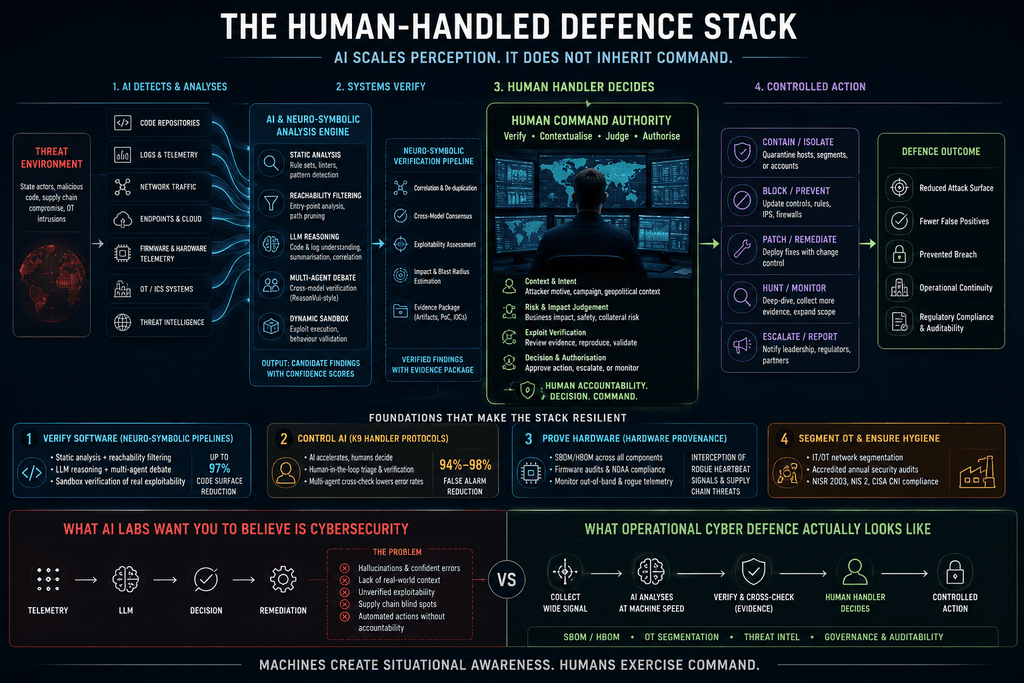
CISOs, SOC directors, and defence procurement officials must implement a human-directed, neuro-symbolic security architecture4.
Additionally, this supports cyber resilience against sophisticated state-sponsored threat actors.
Deploy Neuro-Symbolic Verification Pipelines
Organisations must decouple code security verification from standalone generative AI tools6. Software analysis frameworks should combine static analysis rule sets, entry-point reachability filtering, and dynamic sandbox execution with LLM reasoning18. Following the OpenAnt framework, codebases must be pre-filtered for external reachability prior to AI analysis.
Additionally, this suppresses unattainable execution paths and reduces analysed attack surfaces by up to 97%.
2. Operationalise the Human-in-the-Loop “Handler” Protocol
Security leaders must structure operations around Human-AI Teaming (HAT) principles12. Generative AI should be deployed as a high-speed analytical sensory asset to aggregate logs, summarise telemetry, and propose anomaly candidates12. Human security handlers must retain command authority over context evaluation, exploit verification, and remediation execution5. Implementing multi-agent debate loops (such as ReasonVul) further lowers error rates by requiring models to cross-verify findings before escalating alerts to human analysts1.
3. Mandate Hardware Component and Firmware Traceability
The supply chain compromise of the Royal Navy Kraken K3 Scout USVs demonstrates the necessity of strict hardware provenance6. Defence procurement programs must enforce comprehensive Software and Hardware Bill of Materials (SBOM/HBOM) audits across all components—including cameras, sensors, microcontrollers, and wireless modules1. Organisations must enforce strict NDAA compliance, conduct hardware firmware audits, and monitor out-of-band network communications to intercept rogue heartbeat transmissions 1.
4. Prioritise Operational Technology (OT) Hygiene and Regulatory Governance
As demonstrated by the Iranian cyber attack on the UK power station, physical infrastructure security relies on basic operational hygiene.
Moreover, infrastructure operators must enforce physical and logical air-gapping between IT and OT networks.
They should run health checks with independent auditors and ensure compliance with NISR 2003, NIS 2, and CISA CNI directives.
| Operational Pillar | Technical & Strategic Directives | Expected Defence Outcome | Primary Benchmark |
| 1. Neuro-Symbolic Pipeline | Integrate static rules, reachability pre-filtering, LLMs, and sandboxed exploit execution | Eliminates unattackable paths; verifies real exploitability | 97% code surface reduction4 |
| 2. K9 Handler Protocols | Deploy LLMs for log processing while restricting triage authority to human handlers | Eliminates alert fatigue while preventing hallucinated patch deployments | 94%–98% false alarm reduction5 |
| 3. Hardware Provenance | Conduct HBOM audits, mandate NDAA compliance, and monitor out-of-band telemetry | Prevents hardware subversion and unauthorised background transmissions | Interception of rogue heartbeat signals19 |
| 4. Foundational OT Hygiene | Enforce IT/OT network segmentation and execute accredited annual security audits | Maintains regulatory compliance and protects critical infrastructure | Adherence to NISR 2003 & NIS 2 mandates9 |
Strategic Conclusions
- Autonomous AI Cyber Defence is a Silicon Mirage: Standalone LLMs lack global repository context, introducing high false-positive rates and hallucinations—including a 19.7% package dependency fabrication rate, when deployed without deterministic verification6.
- The K9 Handler Model Optimises Security Operations: Human-AI Teaming (HAT) frameworks, where AI processes wide-spectrum telemetry under continuous human supervision, deliver optimal defence results, eliminating 94% to 98% of static analysis noise2.
- Geopolitical Threats Target Physical Vectors Beyond AI Visibility: Critical national security risks originate from hardware supply-chain subversion (such as the Royal Navy Kraken USV fleet breach) and direct OT attacks (such as the July 2026 UK power plant outage)6. Application-layer AI tools are blind to these physical vectors.
- Resilience Depends on Foundational Security Governance: Regulatory enforcement, demonstrated by the ONR’s £332,500 prosecution of Sellafield Ltd, penalises operational governance failures and unperformed health checks rather than a lack of AI adoption. True cyber defence requires disciplined management, supply-chain verification, and human-led oversight9.
References & Further Reading
- Evaluating Large Language Models in Cybersecurity: A Systematic Taxonomy and Empirical Analysis – MDPI, https://www.mdpi.com/2079-9292/15/10/2222
- A security control recommender approach with human in the loop for, https://colab.ws/articles/10.1007%2Fs44354-026-00033-2
- (PDF) Human-in-the-Loop Intelligence: Advancing AI-Centric Cybersecurity for the Future, https://www.researchgate.net/publication/377295006_Human-in-the-Loop_Intelligence_Advancing_AI-Centric_Cybersecurity_for_the_Future
- OpenAnt: LLM-Powered Vulnerability Discovery Through Code Decomposition, Adversarial Verification, and Dynamic Testing – arXiv, https://arxiv.org/html/2606.19149v2
- Reducing False Positives in Static Bug Detection with LLMs: An Empirical Study in Industry, https://www.researchgate.net/publication/400117710_Reducing_False_Positives_in_Static_Bug_Detection_with_LLMs_An_Empirical_Study_in_Industry
- U.K. naval drone component sent signals to China, raising concerns (EUAD:BATS), https://seekingalpha.com/news/4630280-u-k-naval-drone-component-sent-signals-to-china-raising-concerns
- https://www.theguardian.com/world/2026/aug/23/iran-linked-hackers-blamed-cyber-attack-british-power-plant
- UK Power Plant Disabled for Four Days by Iran-Linked Hackers, Concurrent with US Water Attacks, https://securityaffairs.com/197734/cyber-warfare-2/uk-power-plant-disabled-for-four-days-by-iran-linked-hackers-concurrent-with-us-water-attacks.html
- Cybersecurity in the Nuclear Industry: US and UK Regulation and the Sellafield Case, https://www.womblebonddickinson.com/us/insights/articles-and-briefings/cybersecurity-nuclear-industry-us-and-uk-regulation-and-sellafield
- Artificial Intelligence-Based Correlation and Prioritization of Security Incidents: A Critical Review | OpenReview, https://openreview.net/pdf?id=3qFtGLGyO3
- Finding Vulnerabilities via LLM-Augmented Semantics-Aware Type-Checking – arXiv, https://arxiv.org/html/2608.14533v1
- UK’s Royal Navy sea drones contain component that secretly sent data to China, report claims — government cuts camera connectivity and insists data wasn’t sensitive, only ‘heartbeat communications’ | Tom’s Hardware, https://www.tomshardware.com/tech-industry/drones/uks-royal-navy-sea-drones-contain-component-that-secretly-sent-data-to-china-report-claims-government-cuts-camera-connectivity-and-insists-data-wasnt-sensitive-only-heartbeat-communications
- Chinese-Made Components on UK Naval Drone Cameras Sent Info to Beijing – Kyiv Post, https://www.kyivpost.com/post/82061
- Research on Prompt Engineering to Enhance LLM-Driven CPG Vulnerability Reachability, https://www.sciopen.com/article/10.32604/cmc.2026.075938
- Detecting Code Vulnerabilities using LLMs – Semantic Scholar, https://www.semanticscholar.org/paper/Detecting-Code-Vulnerabilities-using-LLMs-Huynh-Zhang/9ead7634ac0364fc548f7f39db0ffa01e728112e
- Royal Navy drone cameras sent heartbeat signals to China, MoD confirms – BetaNews, https://betanews.com/article/royal-navy-drones-china-heartbeat-signals/
- UK MoD says no data leaked to China via drone vulnerability – Euractiv, https://www.euractiv.com/news/uk-mod-says-no-data-leaked-to-china-via-drone-vulnerability/
- UK Navy forced to strip out internet connectivity from drones after finding it sent ‘heartbeat communications’ to China – TechRadar, https://www.techradar.com/pro/uk-navy-strips-internet-connectivity-from-drones-after-finding-it-sent-heartbeat-communications-to-china
- Spy cams on British Navy drones sent signals to China, says Telegraph report. UK denies data breach – ThePrint, https://theprint.in/world/spy-cams-on-british-navy-drones-sent-signals-to-china-says-telegraph-report-uk-denies-data-breach/3011278/
- UK’s largest nuclear site denies being hacked but pleads guilty over cybersecurity failures, https://therecord.media/sellafield-guilty-plea-uk-nuclear-facility-cybersecurity
- UK nuclear plant cyber failures expose national security risk, https://nationalsecuritynews.com/2024/08/uk-nuclear-plant-cyber-failures-expose-national-security-risk/
- Sellafield Ltd fined in court for cyber security shortfalls | Office for Nuclear Regulation, https://www.onr.org.uk/news/all-news/2024/10/sellafield-ltd-fined-332-500-for-cyber-security-shortfalls
- Sellafield nuclear waste dump to be prosecuted for alleged cybersecurity offences, https://www.theguardian.com/business/2024/mar/28/sellafield-nuclear-waste-dump-to-be-prosecuted-for-alleged-it-security-offences
- A Strategic Analysis of Iranian Cyber Operations – https://nocturnalknight.co/the-asymmetric-frontier-a-strategic-analysis-of-iranian-cyber-operations-and-geopolitical-resilience-in-the-2026-conflict/