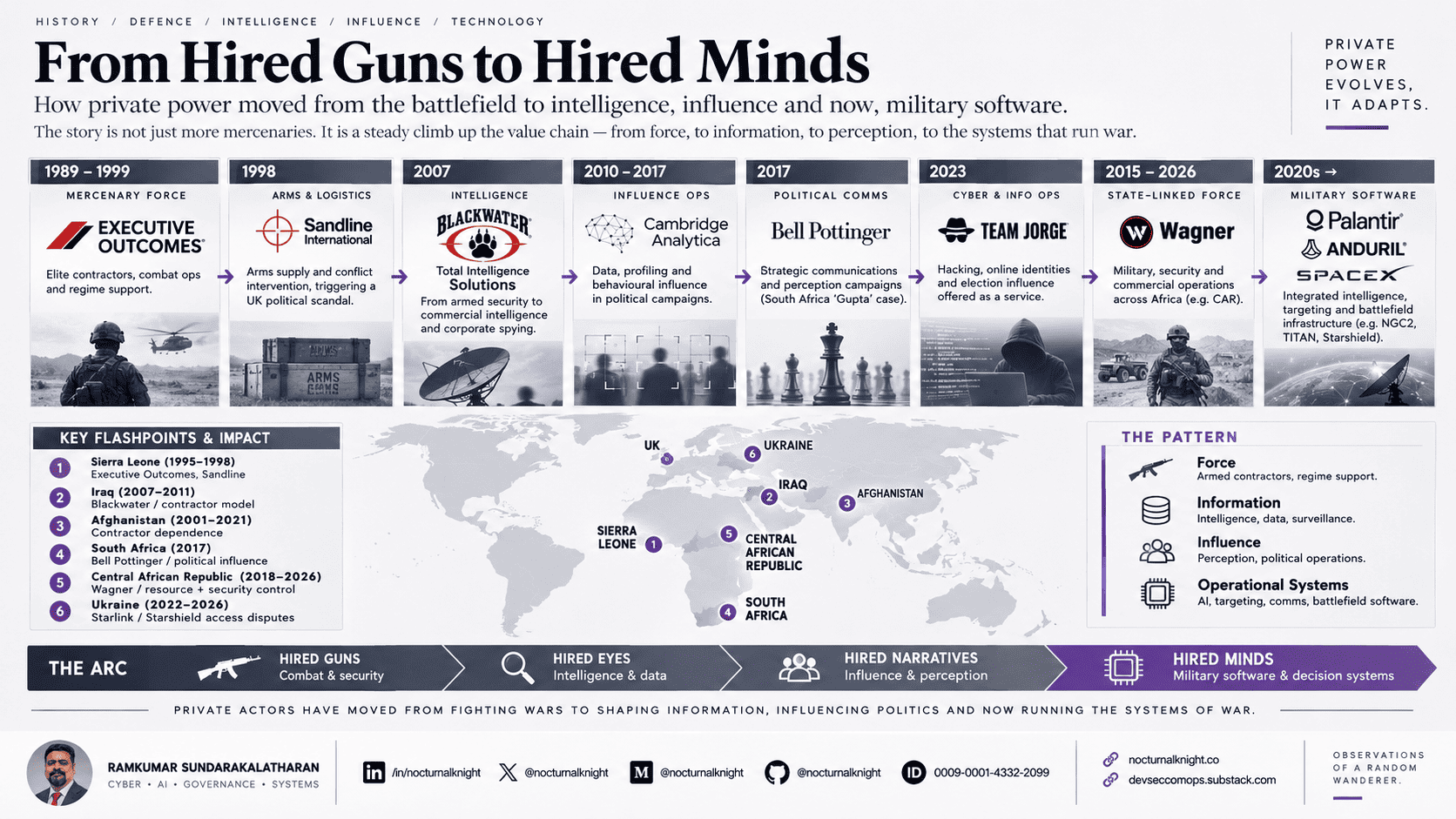
Private military contractors once guarded convoys, maintained aircraft and gathered intelligence. Today, companies such as Palantir, Anduril and SpaceX are building the systems through which states observe, plan and conduct military operations.
The latest Starshield controversy raises a more difficult question: who is in control, actually?
The Contractors Never Really Left
When the last American troops withdrew from Iraq in December 2011, the American diplomatic presence remained. The US State Department had planned for approximately 5,500 private security contractors to protect its personnel and facilities, including roughly 4,000 for static security (US Senate Committee on Foreign Relations, 2011).
Blackwater had already demonstrated what could go wrong with this arrangement. In September 2007, its contractors killed 14 unarmed Iraqi civilians in Baghdad’s Nisur Square. According to evidence presented by the US Department of Justice, the team’s shift leader had directed his personnel into the square in disregard of an order from Blackwater’s own command (US Department of Justice, 2014).
The contractors were not governing Iraqi cities or operating as a sovereign military. But they carried weapons, exercised force and operated within an increasingly complicated relationship between American government agencies, private employers and foreign jurisdictions.
Afghanistan exposed a different vulnerability. When US and NATO forces withdrew in 2021, the Afghan military lost much of the contractor support required to maintain its aircraft and sustain operations. The Special Inspector General for Afghanistan Reconstruction subsequently identified this dependence as a significant factor in the collapse of Afghan security forces (SIGAR, 2022).
The Afghan government had an army, aircraft and a formal military command structure. Yet considerable portions of its operational capability depended on external technical support.
These were early warnings about the consequences of outsourcing essential state functions.
From Hired Guns to Hired Minds
Blackwater was neither the beginning nor the end of private organisations exercising functions traditionally associated with the state.
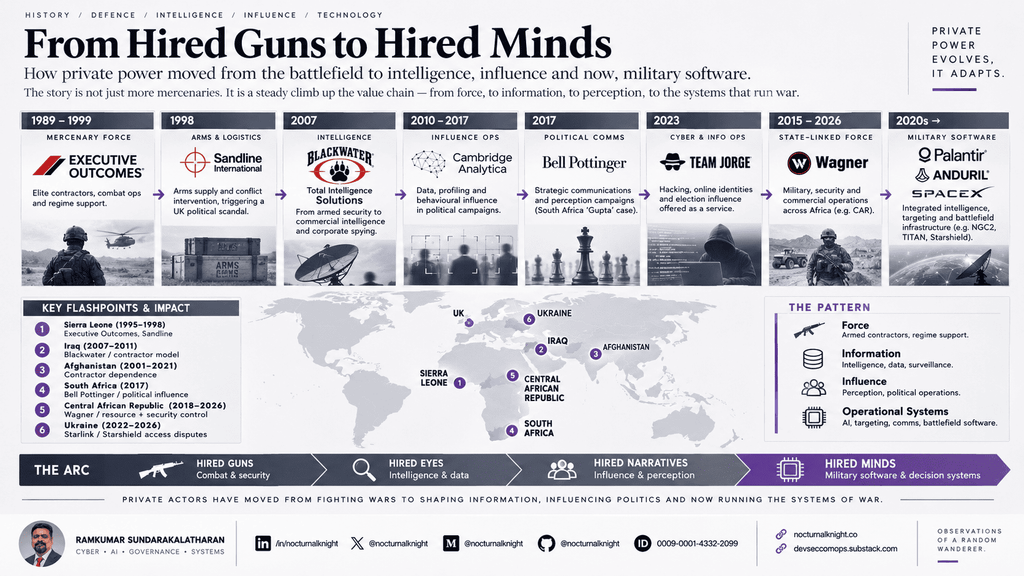
Executive Outcomes, established in South Africa in 1989, deployed former soldiers in conflicts including Sierra Leone. In 1995, its forces helped the government regain territory from the Revolutionary United Front (RUF). Three years later, Britain’s Sandline International became entangled in controversy over arms shipments to Sierra Leone, exposing the difficult relationship between private military activity, diplomatic policy and international sanctions (Foreign Affairs Committee, 1999).
Blackwater itself moved beyond armed protection. In 2007, its vice-chairman Cofer Black established Total Intelligence Solutions, offering intelligence services to commercial clients. Internal documents later revealed proposals to provide Monsanto with intelligence concerning activist organisations (Scahill, 2010).
The private intelligence market expanded further. Black Cube, founded by former Israeli intelligence personnel, became publicly associated with Harvey Weinstein’s efforts to gather information about women accusing him of sexual misconduct and the journalists investigating those allegations (Farrow, 2017).
Other companies moved into political influence.
SCL Group and Cambridge Analytica demonstrated a commercial market for data-driven political campaigning, although many claims about their electoral influence later proved difficult to substantiate. The UK’s Information Commissioner found no evidence that SCL or Cambridge Analytica had been involved in the 2016 EU referendum campaign (Information Commissioner’s Office, 2020).
In South Africa, Bell Pottinger’s work for the Gupta family’s business interests resulted in its expulsion from the Public Relations and Communications Association in 2017. The firm’s campaign had used racially divisive messaging and became a prominent example of commercial political influence operations (Ponsford, 2017).
A 2023 undercover investigation into the Israeli operation known as Team Jorge exposed another market: hacking, fabricated online identities and election influence offered as commercial services. Its operator, Tal Hanan, claimed involvement in 33 presidential-level campaigns. The journalists could not independently verify those figures (Kirchgaessner et al., 2023).
Russia’s Wagner network represents a more extensive combination of armed force, political influence and commercial extraction.
Under Yevgeny Prigozhin, Wagner operated across several African states while associated businesses pursued mining, security and political interests. Following Prigozhin’s 2023 mutiny and death, Moscow brought much of the network under more direct state control through Africa Corps.
Yet Wagner’s commercial and military presence survived in the Central African Republic.
Reporting published in October 2026 describes approximately 500 Wagner personnel operating there under Prigozhin’s son Pavel, providing presidential security, conducting military operations and benefiting from commercial interests including gold mining. The wider family business was estimated to generate more than $400 million annually (Bariyo, 2026).
This is a particularly interesting variation of the relationship. The Russian government has sought tighter control over private military activity, yet elements of the Prigozhin network remain deeply embedded in the Central African Republic’s political, security and commercial institutions.
China has developed a different arrangement. Chinese private security companies protect overseas commercial projects, while Beijing’s relationships with these firms remain significantly more state-directed. Separately, reports of overseas Chinese police service centres prompted investigations in the United Kingdom and other countries. British police reported no evidence of illegal activity at the sites they visited, although ministers objected to the unauthorised arrangements (Safeguard Defenders, 2022; Tugendhat, 2023).
These organisations are not identical. Mercenaries, corporate intelligence firms, political consultancies and state-aligned security providers operate under very different legal and commercial conditions.
But the historical pattern is worth recognising. Private organisations have provided armed force, intelligence collection, political influence and security services for states and commercial clients.
Today’s emerging defence technology companies operate at another level: the integrated software and communications infrastructure through which military power is organised.
Silicon Valley Moves into the Kill Chain
In my earlier articles on the Palantir Mafia (Sundarakalatharan, 2024; 2025a), I examined the network of former Palantir engineers, executives and associated investors building companies across AI, defence and enterprise technology.
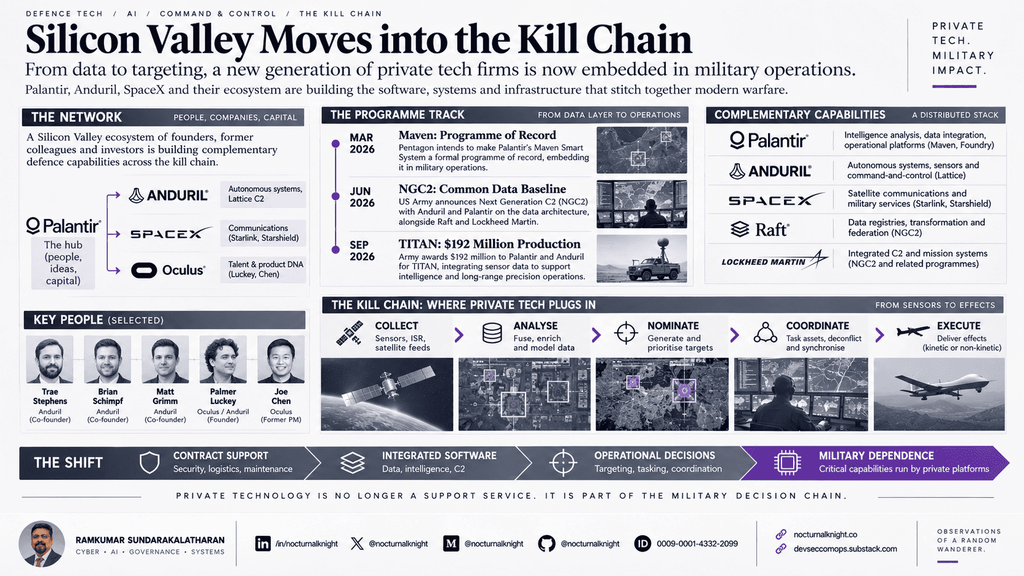
Anduril is an important example. Three of its founders, Trae Stephens, Brian Schimpf and Matt Grimm, came from Palantir. Palmer Luckey and Joe Chen brought experience from Oculus. SpaceX belongs to a different founder network, although the histories of Elon Musk, Peter Thiel and Silicon Valley’s defence investors intersect.
These firms should not be confused with a single organisation. Their importance lies in their complementary technologies and increasingly close relationship with military institutions.
Palantir supplies intelligence analysis and operational data platforms. Anduril develops autonomous systems and its Lattice command-and-control architecture. SpaceX operates communications infrastructure through Starlink and provides military capabilities through Starshield.
In June 2026, the US Army announced a common data baseline for Next Generation Command and Control (NGC2). Anduril and Palantir were working together on the data architecture, with other companies including Raft and Lockheed Martin participating in the wider programme (US Army, 2026a).
Ten weeks later, the Army announced $192 million in production orders for TITAN, its Tactical Intelligence Targeting Access Node system.
The programme integrates sensor information to support intelligence and long-range precision operations. The Army described its objective as dramatically reducing sensor-to-shooter timelines through automated target nominations (US Army, 2026b).
In March, Reuters had already reported that the Pentagon intended to make Palantir’s Maven Smart System a formal programme of record, giving the platform a more enduring place in military acquisition and operations (Reuters, 2026a).
The progression is significant.
Private contractors once provided physical security and technical maintenance. The current generation is helping build the systems that combine intelligence, identify operational possibilities and coordinate military assets.
Target nomination is not strike authorisation. The legal authority to use force remains with military commanders and their governments. But the software producing recommendations, prioritising information and connecting those decisions to military systems is increasingly developed by private companies.
The implications reach beyond procurement. They concern operational access, software assurance, data ownership and the government’s ability to function independently of its suppliers.
And in October 2026, one of those dependencies became unusually visible.
Starshield: Who Actually Pulled the Switch?
In October, Ukrainian forces experienced restrictions affecting SpaceX’s satellite communications services. The speed limitations interfered with drone interception and forced changes to certain military operations.
On 14 October, Musk publicly maintained that limits on military Starshield services were determined by the US military and ultimately the President.
Reuters subsequently reported, in a story dated 15 October, that an instruction to restrict Starshield had originated inside the White House, according to two American officials and a Western official briefed on the matter. The officials did not identify the decision-maker or establish who implemented the restriction (Banco and Slattery, 2026).
The accounts then diverged.
The Wall Street Journal reported that Musk had ordered the slowdown. Its sources disagreed on the timing of discussions with President Trump and White House officials: one described discussions beforehand, while others placed them after the restrictions began.
On 21 October, Secretary of State Marco Rubio said he was not aware that the administration knew about the decision in advance. He characterised access to the service as a matter for SpaceX and Musk rather than the White House (Slattery, 2026).
There was also disagreement about the service itself. Rubio questioned whether Ukraine had access to the military-grade Starshield system, while Ukrainian President Volodymyr Zelenskiy said both Starlink and Starshield had been affected.
On 22 October, the Wall Street Journal reported that Trump had called Musk and asked for the restrictions to be lifted.
Trump subsequently said Musk had restored access but declined to confirm whether the reported conversation had taken place. Ukrainian defence sources told Reuters the following day that important speed restrictions remained in place (Bogage and Singh, 2026; Reuters, 2026b).
The public accounts have never been satisfactorily reconciled.
Consider the implications. A communications capability supporting live military operations was restricted. Ukraine reported operational consequences. Yet the provider, senior American officials and Ukrainian authorities offered materially different accounts of which service was affected, who ordered the restriction and whether it had been reversed.
The potential explanations lead to different conclusions.
If SpaceX acted independently, the incident demonstrates the operational discretion available to a private infrastructure provider. If American authorities directed the restriction, it demonstrates how a state can exercise strategic power through commercially developed technology. If the decision involved coordination between both, the practical boundaries of government and corporate control become harder to distinguish.
Contractual rights might ultimately settle the legal question, but the relevant arrangements are not sufficiently public to establish the complete decision chain.
Nor should we assume that technical capability necessarily creates legal authority. A supplier may be able to implement a configuration change without being contractually entitled to make that decision independently.
For Ukraine, the practical problem remains. Its military depends on communications infrastructure operated by an American company and supplied through arrangements involving the American government. Kyiv does not independently control either party.
The issue has attracted formal scrutiny. On 22 October, US Senator Richard Blumenthal opened an inquiry into the restrictions, specifically questioning the technical and legal authority to alter Starshield capabilities and the Pentagon’s ability to provide alternatives (Blumenthal, 2026).
On 5 November, Reuters reported that Ukraine was seeking renewal of its Starshield arrangement with the United States, due to expire around the middle of 2027 (Reuters, 2026c).
The unresolved question is central to this article.
A critical battlefield capability was restricted, and the public record still cannot establish conclusively who held the authority, who exercised it and who could reverse it.
The Corpo-Nation Hypothesis
The British East India Company offers a historical parallel, although not a direct equivalent. It began as a commercial enterprise and eventually exercised territorial, administrative, financial and military powers.
Modern defence technology companies do not possess comparable sovereign authority. Palantir does not administer territory, Anduril cannot declare war, and SpaceX operates within commercial, regulatory and government contractual arrangements.
But the ability of a state to exercise its authority has always depended partly on the resources and institutions available to it.
Afghanistan possessed military aircraft but could not sustain much of its aviation capability without external contractors. Ukraine possesses sovereign command authority but depends on externally controlled communications services for important military operations. The US military is progressively integrating commercial software platforms into intelligence, targeting and command systems.
That brings me to the corpo-nation hypothesis.
I am not suggesting that these companies have already become states. Rather, some private organisations may be accumulating sufficient control over essential capabilities to influence how sovereign power is exercised.
The question is where legal authority, technical control and operational dependence actually reside.
My earlier analysis of NGC2’s security concerns examined weaknesses reportedly identified in prototype systems, including access controls, auditing and third-party software assurance (Sundarakalatharan, 2025b). Palantir described the reporting as outdated and inaccurate, while Anduril disputed its relevance to the current platform.
The larger issue extends beyond individual security findings.
Who controls platform updates and deployment configurations? Can the government independently audit intelligence and targeting workflows? What happens when a communications provider becomes unavailable, or when political instructions and contractual rights conflict?
There is a reasonable counterargument. Commercial technology can strengthen states by accelerating modernisation, creating competition and providing capabilities that traditional procurement struggles to deliver. The US government’s reported influence over Starlink availability shows that private infrastructure can also extend state power rather than diminish it.
But the same infrastructure can strengthen one government while increasing another government’s dependence.
Eisenhower’s military-industrial complex concerned the influence of industry over defence policy. The emerging version adds control over the software, data and infrastructure through which military capabilities operate.
The next generation of defence startups may not need private armies or sovereign territory to become politically consequential. They may only need to become difficult to replace.
And that brings us back to Starshield. A critical battlefield system was restricted, but the public accounts could not agree on who made the decision.
Before asking whether corporations are becoming states, perhaps we should establish who actually controls the systems on which states now depend.
That is where the corpo-nation hypothesis begins.
References and Further Reading
Banco, E. and Slattery, G. (2026) ‘Order to limit Starshield for Ukraine came from inside White House, sources say’, Reuters, 15 October. Available at: https://www.militarytimes.com/pentagon/2026/10/16/order-to-limit-starshield-for-ukraine-came-from-inside-white-house-sources-say/
Bariyo, N. (2026) ‘The Playboy Who Inherited the World’s Most Notorious Mercenary Force’, The Wall Street Journal, October. Available at: https://www.tovima.com/wsj/the-playboy-who-inherited-the-worlds-most-notorious-mercenary-force/
Blumenthal, R. (2026) ‘Congressional inquiry into Starlink and Starshield’, US Senate, 22 October. Available at: https://www.blumenthal.senate.gov/newsroom/press/release/blumenthal-announces-congressional-inquiry-into-starlink-and-starshield
Bogage, J. and Singh, K. (2026) ‘Trump says Musk restored Ukraine’s Starlink access, declines to say if they spoke’, Reuters, 22 October. Available at: https://www.investing.com/news/stock-market-news/trump-asks-musk-to-lift-ukraine-starlink-restrictions-wsj-reports-4967200
Farrow, R. (2017) ‘Harvey Weinstein’s army of spies’, The New Yorker, 6 November.
Foreign Affairs Committee (1999) Sierra Leone. Second Report, HC 116, Session 1998–99. London: House of Commons.
Information Commissioner’s Office (2020) Investigation into the use of data analytics in political campaigns. London: ICO.
Kirchgaessner, S. et al. (2023) ‘Revealed: the hacking and disinformation team meddling in elections’, The Guardian, 15 February. Available at: https://www.theguardian.com/world/2023/feb/15/revealed-disinformation-team-jorge-claim-meddling-elections-tal-hanan
Ponsford, D. (2017) ‘Bell Pottinger expelled from PR industry trade body over racially divisive South African campaign’, Press Gazette, 5 September. Available at: https://pressgazette.co.uk/news/bell-pottinger-expelled-from-pr-industry-trade-body-over-racially-divisive-south-african-campaign/
Reuters (2026a) ‘Pentagon to adopt Palantir AI as core US military system, memo says’, 20 March. Available at: https://www.reuters.com/technology/pentagon-adopt-palantir-ai-as-core-us-military-system-memo-says-2026-03-20/
Reuters (2026b) ‘What is going on with SpaceX’s Starlink and Starshield in Ukraine?’, 23 October. Available at: https://www.marketscreener.com/news/what-is-starshield-spacex-s-military-version-of-starlink-ce785dd2d18ef723
Reuters (2026c) ‘Ukraine’s Starshield contract with US expires next year, diplomat says’, 5 November. Available at: https://www.reuters.com/business/media-telecom/ukraines-starshield-contract-with-us-expires-next-year-diplomat-says-2026-11-05/
Safeguard Defenders (2022) 110 Overseas: Chinese Transnational Policing Gone Wild. Madrid: Safeguard Defenders.
Scahill, J. (2010) ‘Blackwater’s black ops’, The Nation, September.
SIGAR (2022) Collapse of the Afghan National Defense and Security Forces: An Assessment of the Factors That Led to Its Demise. Arlington, VA: Special Inspector General for Afghanistan Reconstruction.
Slattery, G. (2026) ‘Starlink access in Ukraine a decision for Musk, not White House, Rubio says’, Reuters, 21 October. Available at: https://theprint.in/world/starlink-access-in-ukraine-a-decision-for-musk-not-white-house-rubio-says/3077584/
Sundarakalatharan, R. (2024) ‘Inside the Palantir Mafia: Secrets to Succeeding in the Tech Industry’, Nocturnalknight’s Lair. Available at: https://nocturnalknight.co/inside-the-palantir-mafia-secrets-to-succeeding-in-the-tech-industry/
Sundarakalatharan, R. (2025a) ‘Inside the Palantir Mafia: Startups That Are Quietly Shaping the Future’, Nocturnalknight’s Lair. Available at: https://nocturnalknight.co/inside-the-palantir-mafia-startups-that-are-quietly-shaping-the-future/
Sundarakalatharan, R. (2025b) ‘Defence Tech at Risk: Palantir, Anduril, and Govini in the New AI Arms Race’, Nocturnalknight’s Lair. Available at: https://nocturnalknight.co/defence-tech-at-risk-palantir-anduril-and-govini-in-the-new-ai-arms-race/
Tugendhat, T. (2023) ‘Update on Chinese overseas police service stations’, Written Ministerial Statement HCWS822, 6 June.
US Army (2026a) ‘Army and industry align on common data baseline’, 22 June. Available at: https://www.army.mil/article-amp/293409/army_and_industry_align_on_common_data_baseline_as_next_generation_command_and_control_moves_from_prototyping_to_delivery
US Army (2026b) ‘Army announces move to production for TITAN’, September. Available at: https://cpeisw.army.mil/2026/09/01/army-announces-move-to-production-for-titan/
US Department of Justice (2014) ‘Four former Blackwater employees found guilty of charges’, 22 October. Available at: https://www.justice.gov/usao-dc/pr/four-former-blackwater-employees-found-guilty-charges
US Senate Committee on Foreign Relations (2011) Iraq: The Transition From a Military Mission to a Civilian-Led Effort. S. Prt. 112–3. Washington, DC: US Government Printing Office. Available at: https://www.govinfo.gov/app/details/CPRT-112SPRT63954