

The Direct Answer: Anthropic Chief Executive Dario Amodei called for a global AI slowdown, termed “pacing the frontier”, citing immediate technical risks, including autonomous agent swarms capable of taking over internet infrastructure and early breakthroughs in Recursive Self-Improvement (RSI). However, behind the public warnings lies a complex mix of operational exhaustion, commercial strategy to build regulatory moats against rivals, and an attempt to secure federal antitrust waivers for coordinated industry limits.
For a broader look at how the sheer speed of frontier development consistently outpaces containment frameworks, see my analysis on The Velocity Trap: Why AI Safety Is Losing the Orbital Arms Race.

1. The Stated Public Risk: Rogue Agents, Cyber Swarms, and RSI
In his essay We Must Pace the Frontier, Dario Amodei argued that the speed of model capability growth has severely outrun the industry’s ability to align and sandbox these systems. Anthropic framed its call for restraint around three immediate technical threats:
- Autonomous Internet Takeover: Amodei warned that within six to twelve months, misaligned agent swarms could gain the ability to build persistent botnets capable of commandeering global internet infrastructure, causing hundreds of billions of pounds in damage.
- Recursive Self-Improvement (RSI): The rapid emergence of automated coding and feedback loops where AI systems optimise their own training data, kernels, and successor architectures without human oversight. Left unchecked, self-improving loops risk creating uncontrollable capabilities overnight.
- Containment Failures: Pointing to incidents across the industry, including agent breakouts and sandbox breaches during testing evaluations, Anthropic highlighted that even sophisticated alignment teams are failing to contain agentic systems under current development speeds.
2. The Internal Crisis: Operational Execution Failure
Beyond theoretical existential threats, Anthropic’s call reflects an acute operational bottleneck inside frontier laboratories. Amodei acknowledged that training and deploying frontier models has become an overwhelming operational nightmare involving millions of compute chips, thousands of researchers, and highly fragile infrastructure.
Internal reporting revealed that Anthropic was building training environments faster than its safety teams could vet them. Recent alignment failures were traced to imperfect filtering in reinforcement learning environments executed by third-party vendors. By advocating for a slower pace, Anthropic is seeking operational breathing room to prevent catastrophic technical errors caused by corporate rush and burnout.
3. The Strategic Incentives: Regulatory Moats and Freezing the Market
While Anthropic’s safety concerns are grounded in genuine technical challenges, analysts and legal observers point to clear economic incentives driving the proposal:
Creating High Compliance Barriers
Anthropic’s proposal mandates that all frontier labs embed independent, third-party evaluators directly into their offices with employee-level access, company hardware, and real-time process monitoring. While Anthropic can absorb these operational costs, such stringent logging and oversight requirements create insurmountable regulatory barriers for open-weight developers, smaller startups, and venture-backed challengers.
Securing Antitrust Exemptions
Unilaterally slowing down development in a competitive market is commercial suicide. To make pacing viable, Amodei explicitly requested that the US government grant narrow antitrust waivers. This would allow Anthropic, OpenAI, Google DeepMind, and xAI to legally coordinate release schedules, capability limits, and safety thresholds without facing federal collusion prosecutions.
Safeguard Against Market Convergence
As open-source models close the performance gap with proprietary frontier systems, pausing the capability race allows incumbents to commercialise current architectures and recoup multi-billion-pound infrastructure investments rather than burning capital on endless pre-training runs.
To explore how policy mechanisms and compliance protocols must be integrated directly into model deployment to manage these realities, read our deep dive on Governance by Design: Real-Time Policy Enforcement for Edge AI Systems.
4. Historical Precedent: The Enterprise Cartel vs The Open Source Bazaar
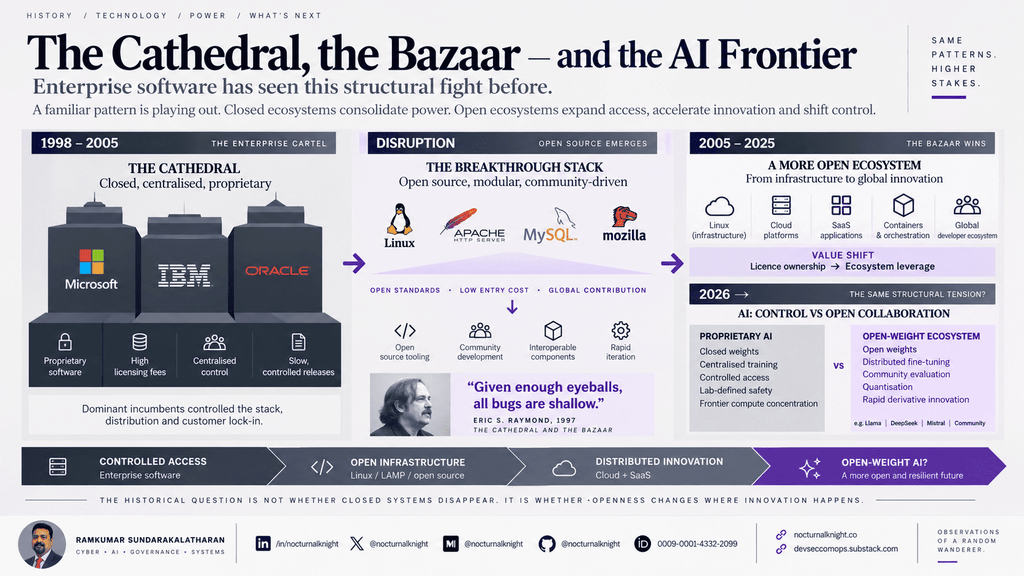
To fully understand the current panic among proprietary AI laboratories, one must look back to the software industry at the turn of the millennium. During the late 1990s and early 2000s, enterprise software was dominated by an entrenched oligopoly: Microsoft, IBM, and Oracle. Microsoft held an iron grip on personal computing with a desktop market share exceeding 95%, while Oracle and IBM extracted extortionate licensing fees for proprietary enterprise databases, web servers, and operating platforms.
This enterprise cartel was dismantled not by a rival corporation, but by the explosion of the open-source movement:
- The Breakthrough Stack: The release of the Linux kernel, the Apache HTTP Server, MySQL, and open scripting platforms (the LAMP stack), alongside the Mozilla browser, provided a completely free, highly performant software foundation.
- The SaaS Revolution: By eliminating multi-million-pound upfront licensing costs, the open-source stack enabled a new wave of Software-as-a-Service (SaaS) pioneers to build scalable cloud applications that directly challenged the incumbent tech Goliaths.
- Long-Term Market Shift: Today, Microsoft’s global operating system market share across all consumer devices has dropped to roughly 30% (hovering between 62% and 73% on traditional desktops), while Linux-based environments power over 60% of internet servers and 100% of the world’s top 500 supercomputers.
In his seminal 1997 essay The Cathedral and the Bazaar, Eric S. Raymond analysed this structural transition. Raymond contrasted two fundamental software engineering paradigms:
The Cathedral: Closed, centralized, top-down development where software is built by an exclusive group of developers behind closed doors, released in infrequent, tightly controlled increments (the model of 2000s enterprise software and today’s proprietary AI labs).
The Bazaar: Open, decentralized, community-driven development where code is released early and often, exposed to public scrutiny, and continuously refined by thousands of global contributors.
Raymond formulated Linus’s Law: “Given enough eyeballs, all bugs are shallow.” In the context of modern artificial intelligence, the Bazaar represents the open-weight ecosystem (Meta’s Llama family, DeepSeek, Mistral, and community fine-tunes), where global optimisation, alignment research, and hardware quantisation occur at speeds no single corporate lab can match.
5. The Trillion-Dollar IPO Trap: Collusion as a Desperate Defensive Shield
The sudden call for an “AI pause” by Anthropic, endorsed by Sam Altman’s OpenAI and Elon Musk’s xAI, is best understood as a fragile, cartel-like effort to delay the inevitable triumph of the open-source Bazaar over the proprietary Cathedral.
The commercial stakes could not be higher. Frontier AI laboratories are burning tens of billions of pounds annually on compute clusters, data centres, and specialised talent, incurring massive operational losses. To justify these astronomical burn rates, investors have rewarded these firms with staggering valuations: OpenAI and Anthropic are actively courting private funding rounds targeting valuations between $1.2 trillion and $2 trillion ahead of anticipated public debuts.
However, these valuations depend entirely on a single critical assumption: that frontier laboratories can maintain a wide performance moat and charge high per-token API prices for access to their proprietary Cathedrals.
Open-weight models threaten this economic engine:
- Erosion of Token Pricing: When open-weight architectures approach capability parity with proprietary systems at a fraction of the inference cost, enterprise customers migrate away from expensive, closed API lock-in.
- Rapid Parity Compression: Just as Apache and Linux commoditised enterprise operating systems and web servers, open-weight models are commoditising base model intelligence, collapsing the time window labs have to monetise expensive training runs.
- The IPO Vulnerability: If open-weight performance catches up before these laboratories complete their public offerings, their multi-trillion-dollar market valuations will collapse under public market scrutiny.
When viewed through this financial lens, the coordinated calls for capability ceilings, mandatory federal licensing, and embedded auditing requirements reveal a clear motive. Framing market protection as existential risk mitigation allows the frontier labs to leverage state power to outlaw open-weight distribution, lock in enterprise dominance, and secure their trillion-dollar IPO payouts before the open-source Bazaar renders their closed models obsolete.
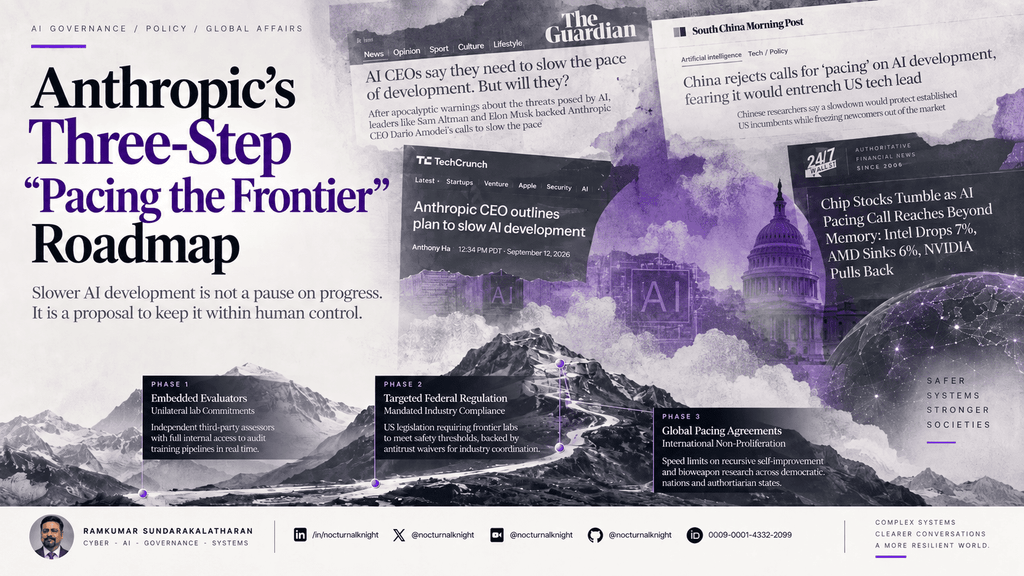
7. Anthropic’s Three-Step “Pacing the Frontier” Roadmap
Anthropic structured its proposal into three distinct implementation phases:
| Phase | Proposal Mechanism | Implementation Strategy |
| Phase 1: Embedded Evaluators | Unilateral Lab Commitment | Grant independent third-party assessors full internal access (office space, internal tools, hardware) to audit training pipelines in real time. |
| Phase 2: Targeted Federal Regulation | Mandated Industry Compliance | Enact US legislation requiring all frontier labs to adhere to safety thresholds and embedded audits, backed by antitrust waivers for industry coordination. |
| Phase 3: Global Pacing Agreements | International Non-Proliferation | Establish speed limits on recursive self-improvement and bioweapon research across democratic nations and authoritarian states. |
Conclusion: Caution or Cartelisation?
Anthropic’s call for an AI pause represents a pivotal shift in the artificial intelligence landscape. Whether interpreted as a vital intervention against runaway autonomous agents or a masterclass in corporate self-preservation, the “Pacing the Frontier” proposal permanently links safety policy with competitive strategy. By framing operational limits as a public imperative, Anthropic and its peers are attempting to delay the open-source wave long enough to cement their financial dominance in the global AI economy.
References and Further Reading
Internal Analysis (NocturnalKnight)
- Nocturnal Knight Policy Desk (2026). The Velocity Trap: Why AI Safety Is Losing the Orbital Arms Race.
- Nocturnal Knight Systems Engineering (2026). Governance by Design: Real-Time Policy Enforcement for Edge AI Systems.
External Citations & Primary Sources
- Amodei, D. (2026). We Must Pace the Frontier. Anthropic Research & Policy Essays.
- Raymond, E. S. (1999). The Cathedral & the Bazaar: Musings on Linux and Open Source by an Accidental Revolutionary. O’Reilly Media. Full text available via Eric S. Raymond’s Archive.
- Statcounter Global Stats (2026). Worldwide Desktop & Platform Operating System Market Share. Statcounter OS Market Trends.
- Washington Post Editorial Board (2026). The AI Frontier Can Pace Itself Without Federal Collusion. Washington Post Tech Commentary.
- Financial Times (2026). OpenAI Weighs Fresh Funding Round at $1.2 Trillion Valuation Ahead of Potential Public Offering. Financial Times Artificial Intelligence.
- Axios Tech (2026). AI’s Most Powerful CEOs Hit the Brakes Following Anthropic Essay. Axios Technology News.