

In August 2026, a major cyberattack attributed to the Rhysida ransomware gang exfiltrated 5.79 terabytes of data from administrative systems in Berlin. When the Berlin Senate Chancellery contracted United States security firm CrowdStrike to deploy its Falcon Endpoint Detection and Response (EDR) agent across municipal networks, the district administration of Lichtenberg formally refused access to its local servers. This operational deadlock highlights a fundamental conflict in modern cybersecurity: tools deployed to contain active breaches require sweeping system privileges that introduce independent operational, regulatory, and jurisdictional risks.
1. What Happened in the Berlin Rhysida Ransomware Attack
The Berlin cyber incident represents one of the largest public-sector data breaches in European history. The incident timeline details how the breach unfolded across state infrastructure:

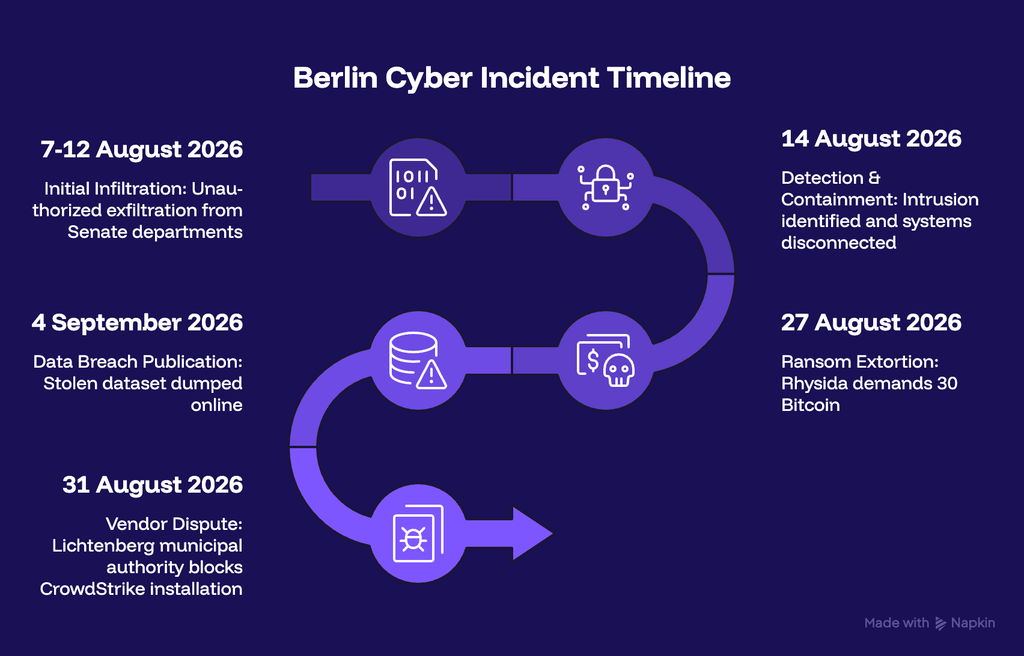
| Phase | Incident Details |
| Initial Infiltration | Unauthorised exfiltration occurred between 7 and 12 August 2026 from Senate departments responsible for housing and transport. |
| Detection & Containment | Intrusion identified on 14 August 2026; affected systems disconnected from the high-speed state fibre-optic network (BeLa). |
| Ransom Extortion | Rhysida demanded 30 Bitcoin (~€2 million / $2.3 million) on 27 August 2026. Berlin officials publicly refused payment. |
| Data Breach Publication | Stolen dataset (5.79 TB across 1.44 million files) dumped online on 4 September 2026, exposing personal data, credentials, and water infrastructure assessments. |
| Vendor Dispute | Senate mandated state-wide CrowdStrike EDR deployment; Lichtenberg municipal authority formally blocked installation on 31 August 2026. |
2. Why Lichtenberg District Refused CrowdStrike EDR Deployment
Internal documentation from the Lichtenberg district administration outlined four primary technical, legal, and operational objections to the mandated software installation:
- Kernel-Level Endpoint Visibility: EDR agents operate with elevated privileges, granting external software unrestricted visibility into system memory, local file storage, and active execution processes.
- Employee and Citizen Privacy: Continuous telemetry collection risks violating General Data Protection Regulation (GDPR) mandates and local data privacy laws by tracking administrative staff device activity.
- System Instability Concerns: Reports from adjacent municipal districts indicated that the EDR agent caused performance degradation and operational conflicts in specialised local administration applications.
- Removal and Persistence Risks: District IT officers cited the inability to independently verify or enforce the complete uninstallation of closed-source kernel components once investigative activities concluded.
3. The Technical Position of EDR Tools in Security Infrastructure
Modern Endpoint Detection and Response platforms function by collecting continuous system telemetry, including:
- Process execution chains and parent-child execution commands.
- Volatile memory structures and system API calls.
- File creation, modification, and deletion events across local storage drives.
- Active network socket connections and domain name system (DNS) queries.
- Authentication tokens, password vaults, and local session credentials.
The high-level administrative access required for EDR telemetry collection mirrors the access targeted by malicious actors. Installing closed-source EDR agents grants external security vendors elevated administrative control across local state infrastructure.
4. Security Risk versus Data Sovereignty Risk
The standoff in Berlin demonstrates that emergency response decisions require balancing competing operational and legal risks:
| Risk Category | Non-Deployment Risk (Operational Security) | Mandatory Deployment Risk (Data Sovereignty) |
| System Visibility | Unmonitored endpoints and undetected threat actor persistence. | External vendor access to sensitive local files and runtime activity. |
| Supply Chain Exposure | Vulnerability to lateral movement across state networks. | Operational dependence on third-party cloud infrastructure. |
| Jurisdiction & Law | System disruption and extortion by criminal groups. | Exposure to foreign extraterritorial subpoenas under the US CLOUD Act. |
| Compliance | Statutory penalties for failing to contain active data exfiltration. | Direct non-compliance with local data protection and privacy statutes. |
Cybersecurity governance during an active breach requires choosing between different categories of risk rather than selecting between security and insecurity.
5. Jurisdiction as an Architectural Property
Standard enterprise security architecture evaluates technical systems across three primary parameters:
- User identity and authentication limits.
- Privilege levels and access authorization boundaries.
- Network segmentation and data flow controls.
Legal jurisdiction constitutes a fourth essential architectural parameter. Evaluating external incident response vendors requires assessing:
- The legal jurisdiction governing the security provider and its parent entity.
- The physical and geographic processing locations of collected diagnostic telemetry.
- Statutory disclosure requirements under foreign extraterritorial laws.
- Independent verification mechanisms for telemetry filtering and agent uninstallation.
6. Governance Failures Before the Rhysida Breach
The dispute in Berlin illustrates the operational danger of deferring emergency access frameworks until an active ransomware breach occurs. Resolving vendor trust models during an ongoing crisis introduces severe administrative bottlenecks:
- Operational containment timelines collapse while system downtime escalates.
- Forensic investigative requirements conflict with pre-existing statutory data protection mandates.
- Local technical administrators face personal or administrative liability for compliance violations without pre-approved legal protections.
7. A “Break-Glass” Emergency Trust Framework for Cyber Incident Response
To prevent operational deadlocks during critical cyber attacks, public sector organisations require pre-negotiated “Break-Glass” trust frameworks containing:
- Pre-Vetted Incident Responders: An established roster of approved external security providers evaluated prior to emergency activation.
- Telemetry Scoping Controls: Technical filters ensuring citizen records and restricted internal databases are excluded from off-site transmission.
- Geographic Data Binding: Contractual requirements stipulating that diagnostic telemetry remains within domestic jurisdictional boundaries.
- Bounded Operational Lifespans: Automatic revocation of elevated administrative permissions and mandatory agent uninstallation upon incident closure.
- Immutable Audit Logging: Independent logging of all actions taken by external responders throughout the remediation period.
8. Delegated Trust in Modern Technology Platforms
The friction observed during the Berlin cyberattack extends beyond individual security vendors. Identical delegated trust challenges exist across modern IT platforms:
- Managed Detection and Response (MDR) services possessing continuous domain administrator credentials.
- Cloud Security Posture Management (CSPM) applications auditing cloud environments.
- Centralised Identity Providers (IdP) managing access boundaries across state infrastructure.
- Autonomous AI remediation engines executing automated system actions.
Defining, auditing, and revoking elevated privileges granted to external protective platforms represents a fundamental requirement for modern security architecture.
Further Reading and References
- CybelAngel (2026) Rhysida Ransomware: Attack Methods, IOCs and Defence 2026. Available at: https://cybelangel.com/blog/rhysida-ransomware-explained-ttps-iocs-and-how-to-defend-in-2026/
- BleepingComputer (2026) Berlin confirms data theft after Rhysida ransomware attack claims. Available at: https://www.bleepingcomputer.com/news/security/berlin-confirms-data-theft-after-rhysida-ransomware-attack-claims/
- Security Affairs (2026) Rhysida Ransomware Group Targets Berlin Government Ahead of Vote. Available at: https://securityaffairs.com/198064/cyber-crime/rhysida-ransomware-group-targets-berlin-government-ahead-of-vote.html
- Security Affairs (2026) Berlin Ransomware Leak Exposes State Secrets. Available at: https://securityaffairs.com/198545/cyber-crime/berlin-ransomware-leak-exposes-state-secrets.html
- Detect FYI (2026) Rhysida in Germany – From an Early Ransomware Payload to the 2026 Stuttgart and Berlin Threat Landscape. Available at: https://detect.fyi/rhysida-in-germany-from-an-early-ransomware-payload-to-the-2026-stuttgart-and-berlin-threat-33e551c2bc02
- CISA, FBI, and MS-ISAC (2023) Understanding Rhysida Ransomware: Joint Cybersecurity Advisory (AA23-319A). Cybersecurity and Infrastructure Security Agency. Available at: https://www.cisa.gov/news-events/cybersecurity-advisories/aa23-319a